 Skip to content
Navigating China's bag manufacturing industry can feel overwhelming, especially for first-time buyers. Thousands of suppliers claim to be manufacturers, but not all of them own factories or have the production capabilities they advertise.
Finding the right supplier isn't simply about comparing prices. It involves evaluating manufacturing experience, production capacity, customization capabilities, quality control systems, communication efficiency, and long-term reliability.
Fortunately, several sourcing channels can help buyers identify suitable suppliers. Traditional B2B platforms such as Alibaba, Made-in-China, and Global Sources remain important sourcing channels, while Google Search has become increasingly valuable for discovering manufacturers with independent websites.
Each platform serves a different purpose, and understanding their strengths and weaknesses can significantly reduce sourcing risks.
In this guide you'll learn:
- Which sourcing platform is best for different purchasing scenarios
- The advantages and disadvantages of Alibaba, Made-in-China, Global Sources, and Google
- How to verify whether a supplier is a genuine manufacturer
- Why independent factory websites are becoming increasingly important
- A practical sourcing strategy used by experienced buyers
What Buyers Should Look for in a Bag Manufacturer
Selecting the right manufacturer is one of the most important decisions during the procurement process. A low quotation means little if the supplier cannot consistently deliver quality products on time.
Rather than focusing only on unit price, buyers should evaluate suppliers from multiple perspectives.
1. Factory or Trading Company
The first question many buyers ask is whether the supplier is a factory or a trading company.
Neither is inherently better. Some experienced trading companies provide excellent service and consolidate multiple factories efficiently. However, if your goal is long-term OEM production, direct communication with the factory often offers advantages such as:
- Better control over production
- Faster technical communication
- More flexibility for customization
- Easier quality management
- Lower communication costs
Instead of relying solely on what the supplier claims, ask detailed production-related questions, such as:
- What production process is used?
- Which materials are available?
- How are bags assembled?
- Can they explain lamination, ultrasonic welding, or sewing methods?
- Can they provide production photos or videos?
Manufacturers usually answer these questions with much greater technical detail.
2. Customization Capability
Most businesses require customized packaging rather than stock products.
A reliable manufacturer should support customization including:
- Bag dimensions
- Fabric GSM
- Material selection
- Printing methods
- Handle styles
- Bottom reinforcement
- Lamination options
- Zippers
- Accessories
- Packaging requirements
The more flexible the factory is, the easier future product development becomes.
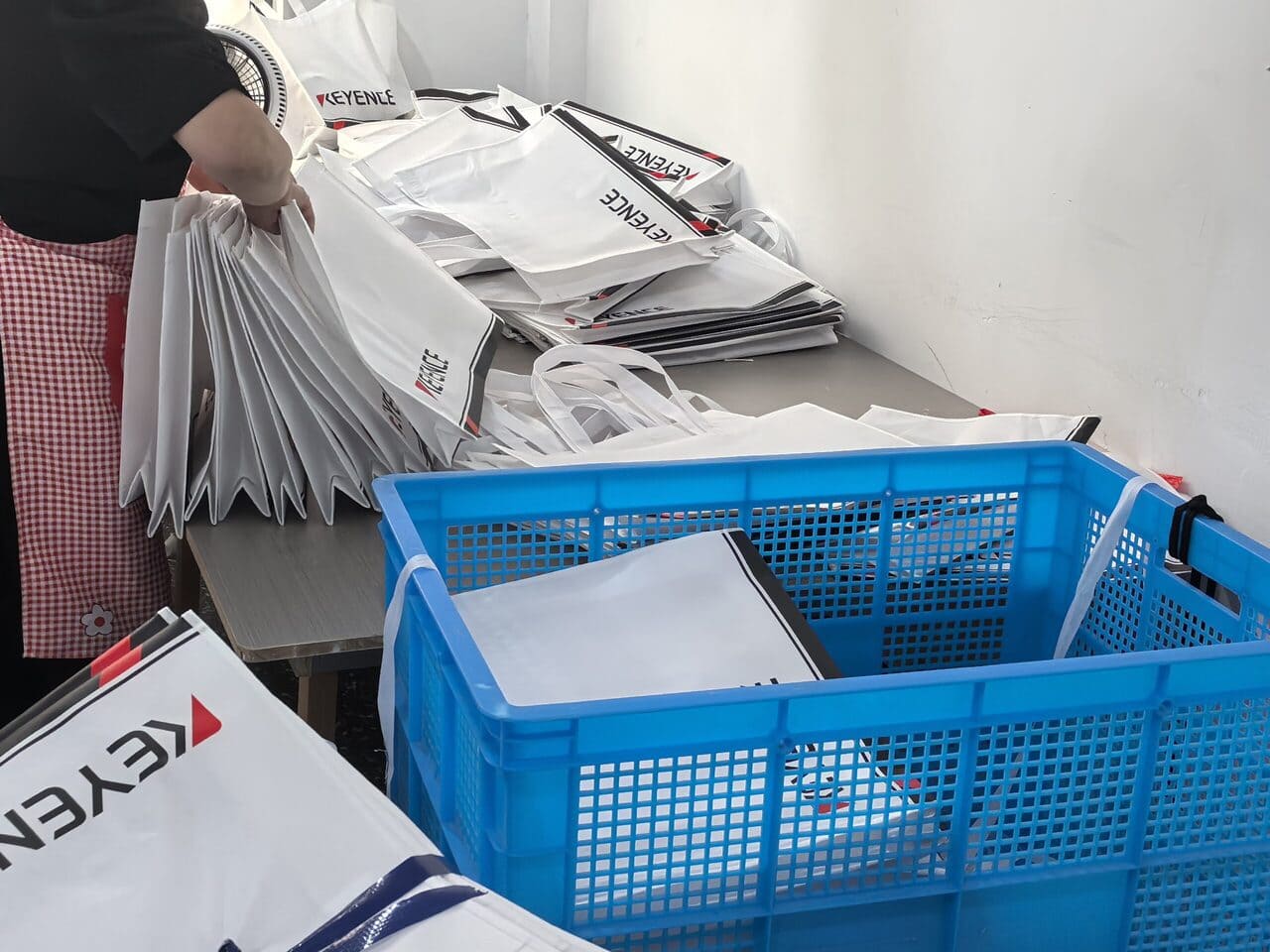
Quality inspection during customized bag production.
3. Production Capacity
Production capacity affects delivery reliability.
Instead of asking "How many workers do you have?", ask questions like:
- Monthly production capacity
- Number of production lines
- Peak season capacity
- Average lead time
- Sample development time
Factories with stable production planning are generally more reliable than those constantly outsourcing production.
4. Minimum Order Quantity (MOQ)
MOQ varies significantly depending on product type.
For example:
| Product | Typical MOQ |
|---|---|
| Non Woven Bags | 500–2,000 pcs |
| PP Woven Bags | 2,000–5,000 pcs |
| Paper Bags | 1,000–3,000 pcs |
| Cooler Bags | 1,000–5,000 pcs |
Very low MOQs are attractive for testing the market, while larger MOQs usually provide better pricing.
5. Certifications
Certifications should support—not replace—supplier evaluation.
Common certifications include:
- ISO 9001
- ISO 14001
- BSCI
- SEDEX
- FSC (for paper bags)
- GRS (for recycled materials)
Keep in mind that certifications alone do not guarantee product quality. They should be considered together with production capability and quality management.
6. Sample Development
Never skip the sampling stage.
Samples allow buyers to verify:
- Printing quality
- Material thickness
- Stitching
- Lamination quality
- Color consistency
- Structural strength
A manufacturer willing to discuss improvements during sampling often becomes a better long-term partner.
Alibaba – The Largest B2B Marketplace
Alibaba is usually the first platform international buyers visit when sourcing products from China.
With millions of suppliers across almost every manufacturing industry, it offers unmatched product variety and supplier coverage.
For bag sourcing, Alibaba remains one of the fastest ways to understand market pricing and identify potential suppliers.
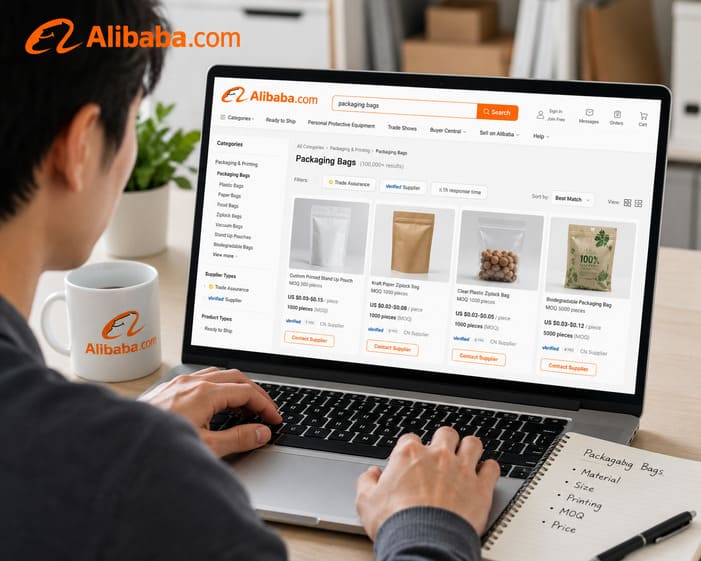
Alibaba offers one of the world's largest selections of bag manufacturers and suppliers.
Advantages
Huge Supplier Database
Whether you're sourcing:
- Non-woven shopping bags
- PP woven bags
- Paper bags
- Cooler bags
- Tote bags
- Drawstring bags
- Promotional bags
you'll likely find hundreds of suppliers within minutes.
This makes Alibaba excellent for early supplier research.
Easy Price Comparison
Multiple quotations can be collected quickly.
Comparing prices helps buyers understand:
- Market price range
- MOQ differences
- Material options
- Printing costs
- Lead times
This is especially useful when building an initial purchasing budget.
Trade Assurance
Alibaba's Trade Assurance program provides an additional layer of protection for eligible orders.
While it does not eliminate all sourcing risks, it offers buyers greater confidence during their first transactions.
Good for Initial Supplier Screening
Alibaba allows buyers to compare:
- Years in business
- Product catalogs
- Customer reviews
- Certifications
- Factory audit reports
- Response speed
This helps narrow down a large supplier list into several promising candidates.
Limitations
Although Alibaba is extremely popular, buyers should also understand its limitations.
Many Suppliers Are Trading Companies
Not every supplier owns a factory.
Some companies coordinate production through partner factories.
This isn't necessarily a problem, but buyers looking for direct manufacturing relationships should perform additional verification.
Quality Varies Widely
Because supplier entry barriers are relatively low, quality standards differ considerably.
Some suppliers operate advanced manufacturing facilities, while others have limited production capabilities.
This makes careful evaluation essential.
Pricing Can Be Misleading
The lowest advertised price is often based on:
- Large order quantities
- Simplified specifications
- Lower material grades
- Different printing methods
Always confirm specifications before comparing quotations.
Best Use Cases
Alibaba works particularly well for:
- First-round supplier research
- Comparing quotations
- Small trial orders
- Understanding market pricing
- Finding multiple product options quickly
However, experienced buyers rarely rely on Alibaba alone. They usually verify suppliers through additional channels before making long-term purchasing decisions.
Made-in-China – Better Visibility of Manufacturing Capabilities
Compared with Alibaba, Made-in-China places greater emphasis on industrial manufacturing.
Although it has fewer suppliers, many buyers find the platform easier to use when sourcing OEM and customized products.
For industrial products such as bags, packaging, machinery, and manufacturing equipment, Made-in-China often provides more structured factory information.
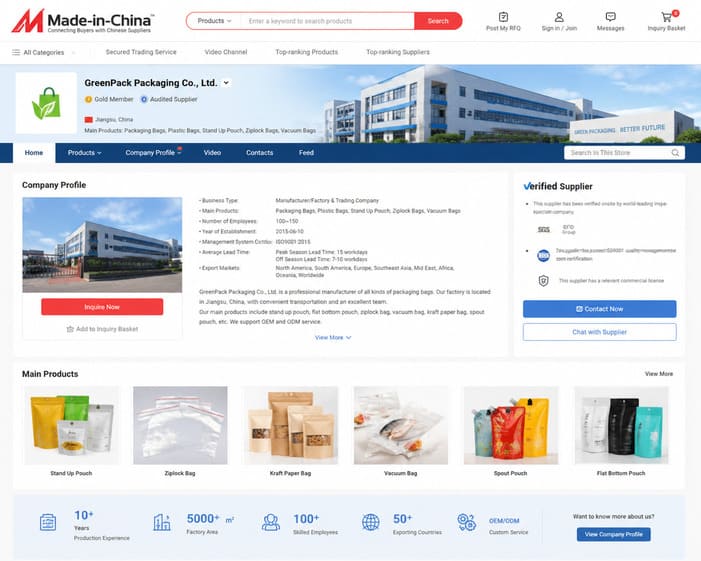
Made-in-China focuses more heavily on industrial manufacturers and OEM production.
Advantages
More Factory-Oriented
Many suppliers on Made-in-China are manufacturers rather than purely trading companies.
Factory information typically includes:
- Production facilities
- Manufacturing equipment
- Workshop photos
- Quality inspection systems
- Export markets
This helps buyers better understand actual production capabilities.
Better for OEM & ODM Projects
If your project requires:
- Custom sizes
- Custom materials
- Custom printing
- Special structures
- New product development
Made-in-China often provides suppliers with stronger manufacturing backgrounds.
This makes technical communication smoother during product development.
Clearer Product Information
Many supplier pages include detailed technical specifications rather than only marketing descriptions.
Buyers can often compare:
- Materials
- GSM options
- Printing methods
- Production processes
- Packaging methods
more efficiently.
Limitations
Made-in-China also has some disadvantages.
Smaller Supplier Base
Compared with Alibaba, the number of suppliers is lower.
This means fewer quotation options for niche products.
Less Active Communication
Some suppliers respond more slowly than those on Alibaba.
Buyers may need additional follow-up during quotation discussions.
Smaller International Buyer Community
Although widely respected, Made-in-China does not have the same international traffic volume as Alibaba.
As a result, user reviews and transaction histories may be less extensive.
Best Use Cases
Made-in-China is particularly suitable for:
- Medium and large OEM orders
- Long-term manufacturing partnerships
- Buyers requiring customized production
- Technical procurement projects
- Factory-focused sourcing
Many experienced buyers use Made-in-China after conducting initial market research elsewhere.
Its stronger emphasis on manufacturing capability makes it especially useful when evaluating suppliers beyond simple price comparisons.
Global Sources – A Premium Platform for Brand Buyers
While Alibaba emphasizes scale and Made-in-China focuses on industrial manufacturing, Global Sources positions itself as a premium sourcing platform connecting international buyers with established Asian suppliers.
It has a smaller supplier base than Alibaba, but many suppliers are export-oriented manufacturers with experience serving retailers, importers, wholesalers, and international brands.
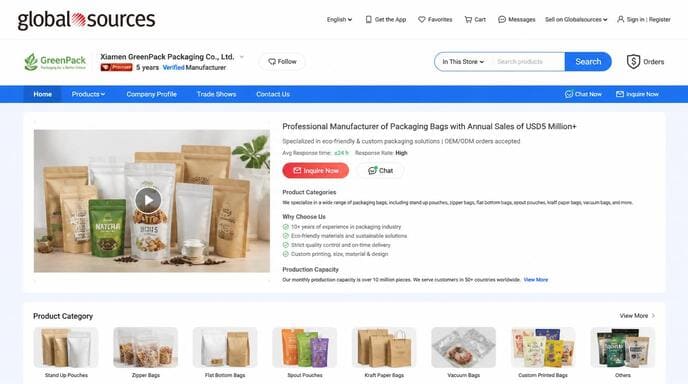
Global Sources combines online sourcing with internationally recognized trade exhibitions.
Advantages
Higher Overall Supplier Quality
Global Sources applies stricter supplier onboarding and verification processes than many open B2B marketplaces.
Although this does not guarantee that every supplier is a factory or that every transaction will be successful, the platform generally attracts companies with stronger export experience, more complete documentation, and greater familiarity with international business practices.
Many suppliers have experience serving:
- Retail brands
- Supermarkets
- Promotional companies
- Packaging distributors
- Importers with long-term purchasing plans
Many suppliers also participate in international trade fairs, allowing buyers to meet them face-to-face before placing large orders.
Better for Brand Purchasing
Global Sources is particularly popular among buyers looking for suppliers capable of maintaining consistent quality standards over the long term.
Factories on the platform are often more familiar with:
- Private label production
- OEM & ODM projects
- Retail packaging requirements
- International compliance
- Long-term supply agreements
If your business depends on stable quality rather than simply finding the lowest quotation, Global Sources is worth considering.
Online and Offline Sourcing Combined
One of Global Sources' biggest advantages is its connection with major sourcing exhibitions, especially in Hong Kong.
Many suppliers exhibiting at these trade shows also maintain active profiles on the platform, giving buyers the opportunity to:
- View products online before visiting
- Schedule factory meetings
- Inspect product samples in person
- Build stronger supplier relationships
This combination of online sourcing and face-to-face communication is particularly valuable for buyers planning larger purchasing programs.
Limitations
Despite its advantages, Global Sources may not suit every buyer.
Higher Prices
Many suppliers focus on quality, compliance, and brand customers rather than competing solely on price.
As a result, quotations are sometimes higher than similar listings on Alibaba.
However, higher pricing may also reflect:
- Better materials
- More stable production
- Improved quality control
- More experienced export teams
Instead of comparing only unit price, buyers should evaluate the total value offered.
Smaller Supplier Selection
Compared with Alibaba, Global Sources lists fewer suppliers.
For highly specialized bag products, buyers may have fewer companies to compare.
Less Frequent Product Updates
Because many suppliers prioritize long-term customer relationships instead of constantly uploading new products, listings may not change as frequently as on larger marketplaces.
This does not necessarily indicate inactive suppliers, but buyers should contact manufacturers directly for the latest product information.
Best Use Cases
Global Sources is an excellent choice for buyers seeking:
- Stable manufacturing partners
- Retail-quality products
- Long-term OEM suppliers
- Experienced exporters
- Suppliers with international trade show experience
For companies building long-term supply chains, it can be an effective complement to Alibaba and Made-in-China.
Google Search – Finding Independent Factory Websites
Over the past several years, Google has become an increasingly important sourcing channel for international buyers.
Rather than relying entirely on B2B marketplaces, many importers now search directly for manufacturers through Google.
This shift has also encouraged more Chinese factories to invest in independent websites, SEO, and digital marketing instead of depending solely on third-party platforms.
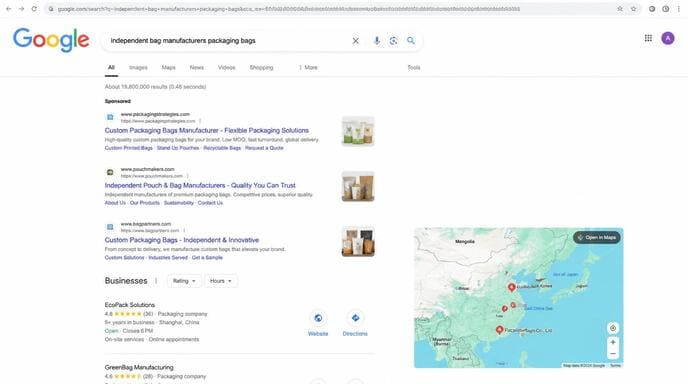
Many Chinese bag manufacturers now operate independent websites alongside traditional B2B platforms.
Why More Factories Are Building Independent Websites
Years ago, many manufacturers relied almost entirely on Alibaba or similar marketplaces for overseas customers.
Today, that approach is changing.
As B2B platforms have become more competitive, many factories have chosen to build their own websites to:
- Establish their own brand identity
- Generate direct inquiries
- Reduce dependence on marketplace traffic
- Showcase production capabilities in greater detail
- Publish technical articles and product guides
- Communicate directly with overseas buyers
An independent website also allows a manufacturer to present much more information than a typical marketplace listing, including factory introductions, production processes, certifications, case studies, videos, and blog content.
This trend is now common among export-oriented manufacturers across many industries, including bag manufacturing.
Advantages of Finding Manufacturers Through Google
Searching Google can uncover suppliers that may not appear prominently on traditional B2B platforms.
Potential advantages include:
Access to More Manufacturers
Some factories invest primarily in their own websites instead of competing for visibility on large marketplaces.
Others may maintain only a basic marketplace profile while directing most of their marketing efforts toward their independent website.
As a result, Google often reveals manufacturers that buyers might otherwise overlook.
More Complete Company Information
Independent websites frequently provide information that cannot fit into a marketplace profile, such as:
- Factory history
- Production equipment
- Manufacturing processes
- Product application guides
- Factory photos
- Production videos
- Blog articles
- Technical resources
- Downloadable catalogs
This additional content helps buyers better understand the company's capabilities before making contact.
Direct Communication
Without a marketplace acting as an intermediary, buyers usually communicate directly with the manufacturer's sales or technical team.
This can make discussions about:
- Product structure
- Materials
- Customization
- Sampling
- Packaging
- Production schedules
more efficient.
Opportunity to Build Long-Term Relationships
Independent websites often reflect a manufacturer's long-term branding strategy.
Companies investing in their own online presence are typically focused on building direct relationships with overseas customers rather than relying exclusively on marketplace traffic.
For buyers seeking long-term OEM partnerships, this direct communication can be beneficial.
Limitations
Finding suppliers through Google also requires more careful evaluation.
Unlike marketplace platforms, Google does not verify manufacturers or provide buyer protection.
This means buyers should conduct their own due diligence before placing orders.
Some independent websites belong to genuine factories, while others may belong to trading companies, marketing agencies, or newly established businesses.
The website itself should never be treated as proof that a company owns a factory.
Instead, it should be considered one piece of the overall evaluation process.
How to Verify an Independent Factory Website
Finding a supplier through Google is only the first step.
The next—and far more important—step is verifying whether the company is credible.
Experienced buyers rarely rely on a single source of information. Instead, they compare information across multiple channels to build a more complete picture of the supplier.
This process is often called cross-verification.
1. Check Whether the Company Appears on Other B2B Platforms
A genuine manufacturer does not need to be present on every platform.
However, many established exporters maintain a presence across multiple channels.
For example, after finding a factory through Google, you can search for the company on:
- Alibaba
- Made-in-China
- Global Sources
- HKTDC
- Thomasnet (for North American marketing)
If the company appears on several platforms with consistent information, this generally increases confidence.
Compare details such as:
- Company name
- Product categories
- Factory location
- Years in business
- Product photos
- Export markets
Consistency is often more important than the number of platforms.
2. Look for LinkedIn Profiles
Many export-oriented manufacturers maintain LinkedIn pages.
A LinkedIn presence may provide additional information about:
- Company history
- Employees
- Sales representatives
- Factory updates
- Customer interactions
An active profile maintained over several years is usually a positive sign, although some legitimate factories may not update LinkedIn frequently.
3. Watch Factory Videos on YouTube
Many manufacturers now publish factory videos on YouTube.
These videos may include:
- Production workshops
- Printing processes
- Sewing lines
- Ultrasonic welding
- Lamination equipment
- Quality inspection
- Container loading
Videos alone do not prove ownership, but they offer valuable insight into the company's production capabilities.
If the same factory layout appears consistently across the company's website, YouTube channel, and social media, this strengthens credibility.
4. Compare Information Across All Channels
Cross-verification is about checking whether information matches.
For example:
- Does the website show the same address as Alibaba?
- Do product photos appear consistent?
- Is the company name identical?
- Do certifications match?
- Are factory photos similar across different platforms?
- Do contact details remain consistent?
Minor differences are normal, but major inconsistencies deserve further investigation.
5. Evaluate Technical Knowledge
One of the most effective ways to identify a genuine manufacturer is through technical communication.
Ask practical questions such as:
- Which GSM is recommended for this application?
- What is the difference between laminated and non-laminated non-woven fabric?
- Which printing method is most suitable?
- How is the handle reinforced?
- What insulation materials are available?
Factories involved in daily production usually provide clear, practical answers rather than generic sales responses.
6. Request Samples Before Mass Production
No online verification can replace physical product evaluation.
Before placing a large order, buyers should request samples to assess:
- Material quality
- Printing accuracy
- Construction
- Dimensions
- Color consistency
- Packaging
A successful sampling process provides much greater confidence than relying solely on online information.
Key takeaway: A company does not need to appear on every platform to be trustworthy. Likewise, having a professional website alone does not prove manufacturing capability. The most reliable approach is to cross-verify information across multiple channels, communicate directly with the supplier, and confirm product quality through samples before placing bulk orders.
Platform Comparison Summary
Each sourcing channel has its own strengths. Rather than asking which platform is "the best," buyers should choose the platform that best fits their purchasing stage and business objectives.
| Platform | Supplier Base | Factory Visibility | Price Level | Reliability | Best For |
|---|---|---|---|---|---|
| Alibaba | Very Large | Medium | Low–Medium | Medium | Initial supplier research, price comparison, small trial orders |
| Made-in-China | Medium | High | Medium | Medium–High | OEM projects, factory sourcing, technical procurement |
| Global Sources | Smaller | High | Medium–High | High | Brand buyers, stable long-term suppliers |
| Google Search | Unlimited | Depends on verification | Varies | Depends on verification | Discovering independent manufacturers and building direct relationships |
Which Platform Should You Choose?
There is no single platform that fits every sourcing situation.
A first-time importer may begin with Alibaba because of its large supplier base and Trade Assurance. Buyers looking for OEM production may prefer Made-in-China for its stronger manufacturing focus. Companies seeking stable, export-oriented suppliers often use Global Sources.
Google should not be viewed as a replacement for these platforms. Instead, it is an excellent complement that helps buyers discover manufacturers who invest in their own websites and branding.
Many experienced importers use multiple sourcing channels simultaneously rather than relying on only one platform.
How to Identify a Real Bag Manufacturer
Whether you find a supplier through Alibaba, Google, LinkedIn, or a trade show, the next step is determining whether the company can genuinely manufacture your products.
Rather than relying on a single indicator, evaluate the supplier from several perspectives.
Production Photos and Videos
A genuine manufacturer is usually willing to share photos or videos of:
- Production workshops
- Printing equipment
- Sewing lines
- Ultrasonic welding machines
- Lamination machines
- Cutting equipment
- Finished product inspection
- Packing and container loading
Professional photos alone do not prove factory ownership, but detailed production content is generally a positive sign.
Product Knowledge
Ask technical questions instead of only requesting prices.
For example:
- Which GSM is suitable for carrying 10 kg?
- Should this bag use ultrasonic welding or sewing?
- What printing method is recommended for full-color artwork?
- Which insulation material provides better thermal performance?
Manufacturers involved in production usually explain the advantages and limitations of different options rather than simply recommending the most expensive solution.
Customization Capability
A reliable factory should understand how different design changes affect production.
Examples include:
- Material selection
- Fabric thickness
- Handle construction
- Bottom reinforcement
- Printing methods
- Packaging requirements
If every request receives the same generic response, further verification may be necessary.
Sampling Process
Professional manufacturers usually encourage sampling before mass production.
During this stage they may discuss:
- Artwork adjustments
- Material recommendations
- Cost optimization
- Production feasibility
- Packaging improvements
This collaborative approach is often a good indicator of manufacturing experience.
Communication Quality
Reliable suppliers generally respond with clear and complete answers.
Good communication often includes:
- Detailed quotations
- Material explanations
- Production suggestions
- Realistic lead times
- Honest discussions about production limitations
Be cautious if every answer immediately returns to price without addressing technical questions.
Common Mistakes Buyers Make
Even experienced buyers occasionally make sourcing mistakes.
Most problems occur before production begins, during supplier selection and communication.
Choosing Only the Lowest Price
A quotation that is significantly lower than all others deserves careful review.
Lower prices may result from:
- Lower material quality
- Different specifications
- Smaller fabric weight
- Simpler construction
- Hidden additional costs
Always compare quotations based on identical specifications.
Relying on Only One Platform
Some buyers trust only Alibaba.
Others believe every supplier found through Google is a factory.
Both assumptions can lead to poor decisions.
Instead, compare information across multiple channels and perform cross-verification whenever possible.
Assuming Every Independent Website Belongs to a Factory
An attractive website is not proof of manufacturing capability.
Some websites belong to:
- Trading companies
- Marketing agencies
- Newly established exporters
This is why checking other channels, requesting samples, and asking technical questions remain essential.
Ignoring Sample Evaluation
Skipping the sampling stage to save time often creates larger problems later.
A sample helps verify:
- Material quality
- Printing
- Construction
- Dimensions
- Color accuracy
- Overall workmanship
Correcting problems before mass production is far less expensive than discovering them after shipment.
Focusing Only on Certifications
Certifications are valuable, but they should not be the only evaluation standard.
A supplier with several certifications may still outsource production, while another manufacturer with fewer certifications may operate an excellent factory.
Evaluate the complete picture rather than one document.
Recommended Sourcing Strategy
Professional buyers rarely depend on a single sourcing channel.
Instead, they combine several methods to reduce risk and identify the most suitable manufacturing partner.
A practical sourcing strategy might look like this:
Step 1 — Research the Market
Start with Alibaba to understand:
- Product varieties
- Market pricing
- MOQ ranges
- Common materials
- Typical lead times
This provides a useful benchmark before contacting manufacturers.
Step 2 — Build a Shortlist
Search for the same suppliers on:
- Made-in-China
- Global Sources
At this stage, compare:
- Company information
- Product offerings
- Factory photos
- Certifications
- Export experience
Remove suppliers with major inconsistencies.
Step 3 — Verify Through Multiple Channels
Before requesting quotations, perform cross-verification.
Check whether the supplier has:
- An official website
- LinkedIn page
- YouTube factory videos
- B2B platform profiles
- Consistent contact information
Remember, not every genuine factory uses every platform. The goal is not to find the most channels, but to determine whether the information available is consistent and credible.
Step 4 — Communicate Technically
Instead of asking only:
"What's your best price?"
Ask questions such as:
- Which material do you recommend?
- Which GSM is suitable?
- Which printing method is better?
- Can the structure be optimized?
The quality of the answers often reveals far more than the quotation itself.
Step 5 — Request Samples
Evaluate:
- Product quality
- Printing
- Packaging
- Delivery speed
- Communication efficiency
If necessary, revise the sample before approving mass production.
Step 6 — Start with a Trial Order
Even after approving samples, consider placing a moderate first order instead of immediately purchasing at full annual volume.
This allows both parties to verify:
- Production consistency
- Delivery performance
- Communication
- Quality control
A successful trial order lays the foundation for a long-term partnership.
Conclusion
Finding reliable bag manufacturers in China is no longer limited to a single sourcing platform.
Alibaba, Made-in-China, Global Sources, and Google each serve different purposes. Rather than choosing one platform exclusively, experienced buyers combine multiple channels to gain a broader understanding of potential suppliers.
Independent factory websites have also become increasingly common. Many manufacturers now invest in SEO and their own websites to communicate directly with overseas buyers and reduce reliance on marketplace platforms. However, an independent website alone should never be considered proof of manufacturing capability.
The most effective approach is to cross-verify supplier information, communicate directly with the company, request samples, and evaluate production capabilities before placing large orders.
Ultimately, successful sourcing is not about finding the cheapest supplier—it is about finding a reliable manufacturing partner that can consistently deliver the quality, service, and support your business requires.
FAQ
Is Google a good way to find China bag manufacturers?
Yes. Google has become an increasingly valuable sourcing channel, especially for buyers looking beyond traditional B2B marketplaces.
Many Chinese manufacturers now operate independent websites where they provide detailed information about their factory, production capabilities, customization options, and technical expertise. These websites often contain more comprehensive content than marketplace listings.
However, Google does not verify suppliers. Buyers should always cross-check the company's information through other channels such as Alibaba, Made-in-China, LinkedIn, YouTube, or industry exhibitions before making a purchasing decision.
How can I verify that an independent factory website is real?
There is no single method that guarantees a website belongs to a genuine manufacturer. The best approach is to evaluate the supplier from multiple angles.
For example, you can:
- Search the company name on Alibaba or Made-in-China.
- Check whether the company has a LinkedIn page.
- Look for factory videos on YouTube.
- Compare company names, addresses, phone numbers, and email domains across different platforms.
- Request recent factory photos or videos.
- Ask technical questions about materials and production processes.
- Request product samples before placing bulk orders.
Remember that a genuine factory may not appear on every platform, and some excellent manufacturers focus primarily on their own websites. What matters most is whether the available information is consistent and credible across multiple sources, rather than how many platforms the company uses.










One Response
Great content! Keep up the good work!