Your food delivery arrives, but it's disappointingly lukewarm. This common problem hurts your brand and customer loyalty. You need a thermal bag that actually works, but which material is best?
Foam insulation, like EPE, generally keeps food hotter for longer than simple foil insulation. Foam works by trapping air to slow heat transfer, while foil primarily reflects heat. For the best performance, a hybrid bag combining a fabric outer layer, a foam core, and a foil lining is ideal.
Choosing the right insulated bag is a critical decision for any business that deals with food transport, from large-scale catering to local meal delivery. The difference between a hot meal and a cold complaint often comes down to the material inside the bag. But it's not just about one material being "good" and another being "bad." The secret lies in understanding how they work and how they can work together. Let's break down the science and compare these materials head-to-head to help you make the smartest choice for your business.
What makes a thermal bag work?
Ever wonder how a simple bag keeps your pizza steaming hot? The science is simpler than you might think, but getting it wrong means cold food and unhappy customers.
Thermal bags work by using an insulation layer to slow down all three types of heat transfer. They create a barrier that stops heat from escaping through conduction, convection, and radiation, effectively keeping hot items hot and cold items cold for an extended period.
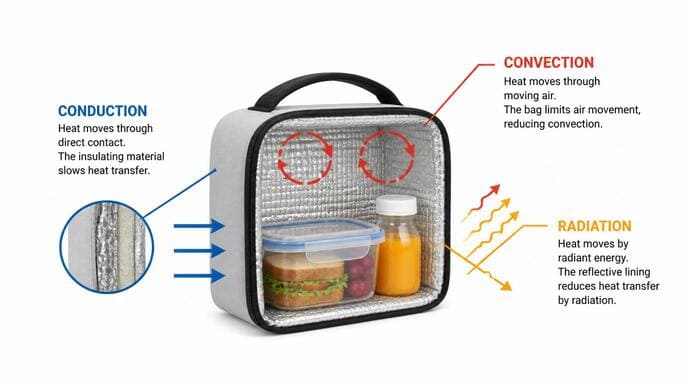
To really understand how an insulated bag functions, we need to look at how heat moves. Heat always tries to move from a warmer area to a cooler one, and it does this in three ways.
The Three Paths of Heat Transfer
| Transfer Type | How It Works | How a Thermal Bag Stops It |
|---|---|---|
| Conduction | Heat moves directly through a solid material. | The insulation material (like foam) is a poor conductor of heat. |
| Convection | Heat moves through the circulation of air or liquid. | The bag's structure traps air, preventing it from circulating. |
| Radiation | Heat travels in the form of electromagnetic waves. | A shiny inner lining (like foil) reflects heat waves back. |
A well-designed thermal bag is built in layers to fight all three. It typically has a durable outer layer, a thick insulation layer in the middle, and a smooth inner lining. By creating this multi-layered barrier, the bag effectively traps the food's thermal energy, ensuring it arrives at its destination at the right temperature.
How does foil insulation keep food warm?
Foil seems so thin. Can it really keep food hot? Many cheap bags use it, but they often fail, leaving customers with lukewarm meals and a poor impression of your brand.
Foil insulation works primarily by reflecting heat radiation. Its shiny surface bounces thermal energy back toward the food source. While lightweight and inexpensive, it is less effective at stopping heat transfer through conduction and relies on an air gap to perform well.
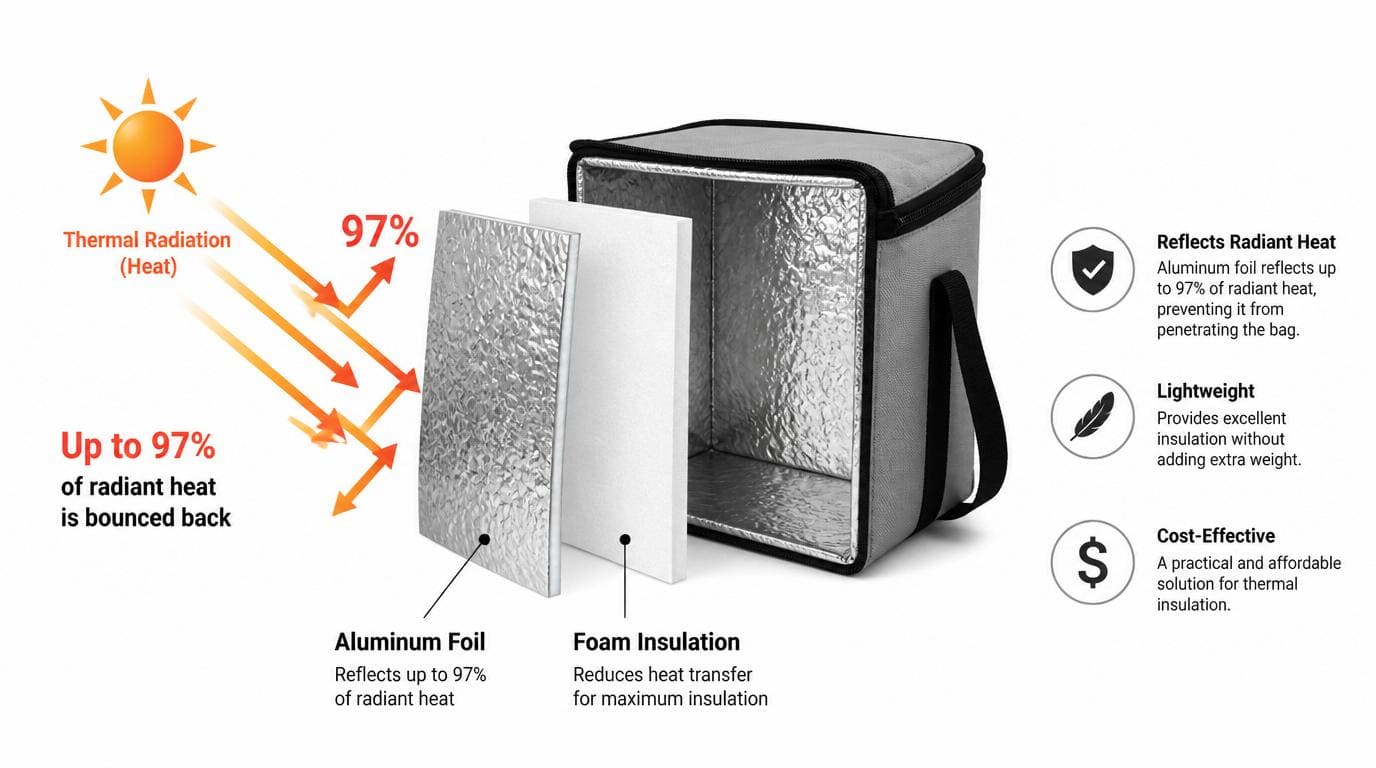
The key principle behind aluminum foil's effectiveness is its low emissivity. In simple terms, shiny surfaces are bad at radiating heat. When your hot food radiates thermal energy, the foil lining acts like a mirror, reflecting up to 97% of that radiant heat right back. This helps keep the warmth contained inside the bag.
However, foil is not a perfect solution on its own. It's a very thin material, so it does little to stop heat loss from conduction (direct contact). If the food container is touching the foil, heat will pass through it easily. Furthermore, foil is prone to wrinkling and tearing. Once it gets crumpled, its reflective ability decreases. That's why foil is most effective when used as part of a multi-layer system, often as an inner lining combined with a thicker insulating material.
Why is foam insulation a popular choice?
You've seen those thicker, sturdier delivery bags. They feel more substantial, but are they worth the extra cost? Choosing the wrong one means overspending for features you don't need or underperforming when it matters most.
Foam insulation, like EPE (Expanded Polyethylene) pearl cotton, works by trapping millions of tiny air pockets. This structure dramatically slows down heat transfer through both conduction and convection, making it excellent for keeping food hot for longer periods.
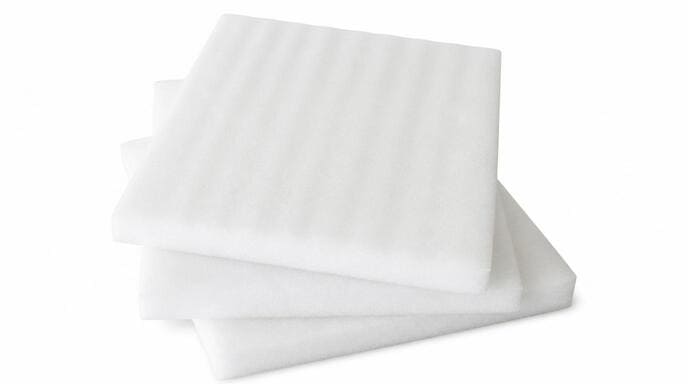
The magic of foam insulation lies in its structure. Air is a very poor conductor of heat. By trapping countless small bubbles of air within its solid structure, foam creates an incredibly effective thermal barrier. Heat struggles to move through it. This makes foam a champion at preventing heat loss through conduction and convection, which are the primary ways food cools down in a container.
At our factory, EPE foam is one of the most common materials we use for professional-grade thermal bags. It offers a fantastic balance of performance, durability, and cost. Unlike simple foil, foam provides structural integrity, helping the bag keep its shape and protecting the contents from being crushed. While it is bulkier and costs more than a thin foil sheet, its superior insulation performance makes it the go-to choice for businesses that depend on reliable temperature control, such as restaurant chains and cold chain logistics companies.
Which material is truly better in a head-to-head comparison?
Deciding between foil and foam can be confusing. One is cheap and lightweight, the other is bulky but performs better. Making the wrong choice can impact your budget, operational efficiency, and your customers' experience.
Foam insulation is clearly better for heat retention and durability, making it ideal for professional food delivery. Foil is a budget-friendly choice for short trips or single-use promotional bags, but it simply can't compete on performance or longevity.
Let's put them side-by-side to see how they stack up across the factors that matter most to a business. As a manufacturer with over a decade of experience, this is how we advise our clients.
Foil vs. Foam: A Manufacturer's Breakdown
| Feature | Foil Insulation | Foam Insulation (EPE) | Winner |
|---|---|---|---|
| Heat Retention | Fair. Good at reflecting radiant heat. | Excellent. Traps air to stop conduction/convection. | Foam |
| Durability | Poor. Easily wrinkles, tears, and punctures. | Good. Resists compression and maintains shape. | Foam |
| Weight & Flexibility | Excellent. Very lightweight and foldable. | Fair. Bulkier and less flexible than foil. | Foil |
| Cost | Low. Very inexpensive raw material. | Medium. More costly but better value over time. | Foil |
| Best Use Scenario | Short-term use, promotional giveaways, lining. | Professional food delivery, long-distance transport. | Foam |
For any business where temperature control is linked to product quality and customer satisfaction, the choice is clear. While foil has its place for low-cost, short-duration tasks, foam provides the reliable, long-lasting thermal performance that professional operations require. The slightly higher initial investment in a foam-insulated bag pays for itself through better performance and a longer service life.
Can you combine foil and foam for the ultimate thermal bag?
What if you didn't have to choose between foil's reflective power and foam's insulating structure? Many businesses miss out on the best performance by sticking to single-material bags, not realizing a hybrid approach exists.
Absolutely. In fact, the best thermal bags on the market almost always use a combination of materials. A hybrid structure, such as a non-woven fabric outer layer, an EPE foam core, and an aluminum foil lining, offers superior insulation by tackling all forms of heat transfer simultaneously.
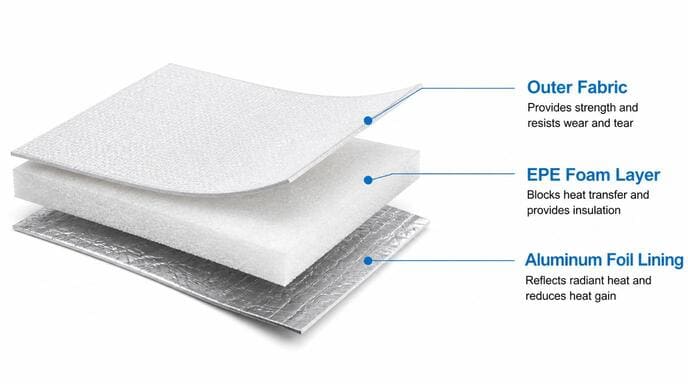
This multi-layer approach is the secret to maximum thermal performance. Here’s why it works so well:
- Outer Layer (e.g., Non-Woven or Oxford Fabric): Provides durability, structure, and a printable surface for branding.
- Middle Layer (EPE Foam): This is the workhorse. It traps air to stop heat loss from conduction and convection. The thickness of the foam (from 2mm to 5mm or more) is the biggest factor in how long the bag will keep food hot.
- Inner Layer (Aluminum Foil): This layer acts as a radiant barrier, reflecting thermal energy (radiation) back to the food. It's also waterproof and easy to clean, which is a huge plus for food safety.
As manufacturers, this is where our expertise shines. We work with clients to engineer the perfect combination based on their specific needs. For a pizza chain, we might recommend a thick 5mm EPE foam for maximum heat retention. For a grocery delivery service carrying mixed goods, a 3mm foam might be sufficient. This custom approach ensures you get the best possible performance for your budget, without over-engineering or under-delivering.
How do you choose the right thermal bag for your business?
With so many options, picking the right bag feels overwhelming. You need a solution that fits your specific needs, budget, and brand without the headache of endless trial and error.
Choose your thermal bag by first defining your primary use case. Then, align that with your budget, durability requirements, and any custom branding needs. This structured approach ensures you get the best value and performance for your investment.
Here at Jiarong, we guide our B2B clients through a simple decision-making process. I always ask them to consider these four points to find the perfect match.
Your 4-Step Checklist for Choosing a Thermal Bag
-
Define Your Primary Use:
- Professional Food Delivery: You need maximum heat retention and durability. A multi-layer bag with thick EPE foam (3mm+) and a foil lining is non-negotiable.
- Cold Chain & Grocery: You need good insulation and a strong, easy-to-clean structure. A sewn bag with foam and a waterproof lining is ideal.
- Promotional Giveaways: The goal is brand exposure at a low cost. A simple non-woven bag with a thin foil lining might be enough.
-
Set Your Budget:
- Entry-Level: Simple foil-lined bags are the most affordable.
- Mid-Range / Professional: Bags with 2-3mm EPE foam offer a great balance of cost and performance.
- Premium Performance: Bags with 5mm+ foam, reinforced stitching, and extra features will cost more but deliver the best results and longest lifespan.
-
Consider Durability:
- How often will the bag be used daily? For high-frequency use, you need reinforced handles (like with cross-stitching), sturdy zippers, and a tough outer fabric like polyester or heavy-duty non-woven.
-
Evaluate Customization Needs:
- Do you need your logo printed? What about specific dimensions to fit your food containers? As an OEM/ODM manufacturer, we can customize everything from material thickness and size to printing methods and handle types. This ensures the bag is a perfect extension of your brand.
By thinking through these points, you move from buying a generic product to investing in a customized business solution.
Conclusion
Foil is a low-cost option for short-term use, while foam provides the superior insulation needed for professional applications. For the best results, a multi-layer bag combining both is the ultimate solution.