Skip to content
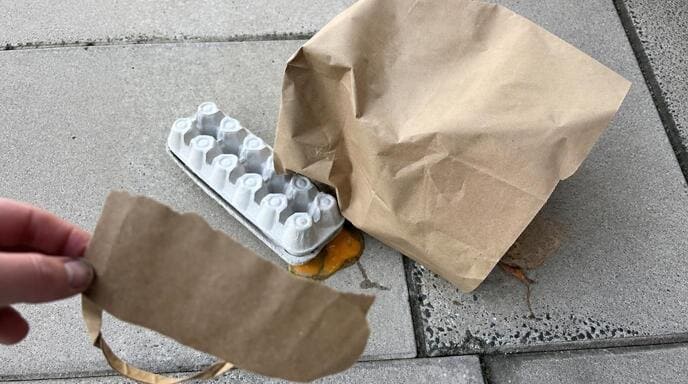
Grocery bags often tear at the handles even when the bag body is still intact. This is mainly because the handle area transfers the weight of the entire bag through a relatively small section of material. A 5 kg load produces approximately 49 N of downward force under static conditions. If two handles share the load evenly, each handle theoretically carries about 24.5 N. In actual use, however, the load is rarely distributed perfectly. Walking, lifting, uneven contents and sudden movements can concentrate additional force on one handle or one section of the attachment.
The result is a common failure pattern: the bag body remains intact while the handle, handle opening or attachment area stretches, tears or separates first.
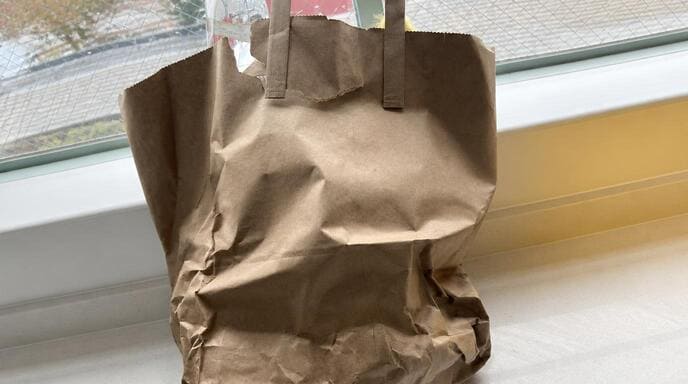
Why Do Grocery Bag Handles Break First?
The main reason is load concentration. The contents are supported by the bottom of the bag, and the resulting force is transferred through the bag panels to the handles and finally to the user's hand:
Contents → bag bottom → bag panels → handle attachment → handle → hand
The main bag panel can distribute the load over a relatively large area, while the handle transfers that same load through a much smaller region. For a 10 kg load, the bag is subjected to approximately 98 N of static gravitational force. When this force passes through a narrow welded area, small stitching zone or die-cut handle opening, the local stress around that area can be much higher than the stress in the surrounding flat panel.
This is why a bag can appear strong overall but still fail at the handles. The problem is often not the overall strength of the material, but the way the load is transferred through the handle structure.
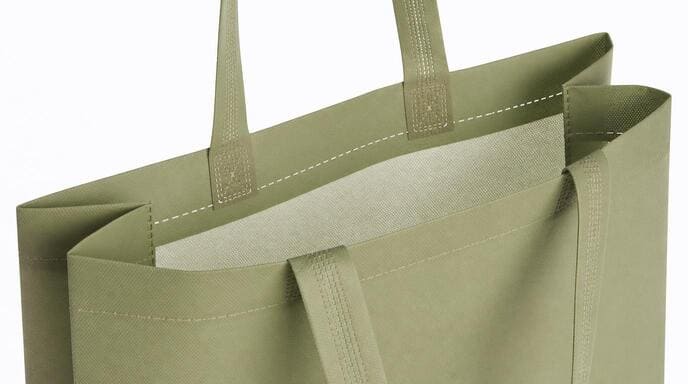
The Handle Opening and Attachment Area Create Local Stress
The geometry of the handle can make the problem more severe. A die-cut handle removes material from the bag panel, forcing the load to travel around the opening. The inner edge of the opening can therefore become a natural stress-concentration point. If the material is too light for the intended load, the edge may stretch and a small tear can propagate toward the upper edge of the bag.
The same principle applies to attached handles. A handle may be relatively strong, but the surrounding fabric can still fail if the attachment area is too small. This is particularly important because the handle itself is not necessarily the weakest component. A strong handle attached to a weak panel can simply transfer the failure to the panel around it.
For this reason, reinforcement is intended not only to make the handle stronger but to spread the load over a larger area of the bag material. Wider attachment areas, reinforcement patches, folded material, webbing, larger welding zones or suitable stitching structures can all help reduce localized stress.
Material Strength, GSM and Attachment Method All Matter
For non-woven shopping bags, GSM is commonly used to describe material weight. Higher GSM generally provides more material mass and can contribute to higher mechanical strength, but GSM alone does not determine handle performance.
A handle problem can occur even when the material itself has adequate strength if the handle opening is poorly designed or the attachment area is too small. Conversely, increasing the material weight may not solve a problem caused by weak welding or stitching.
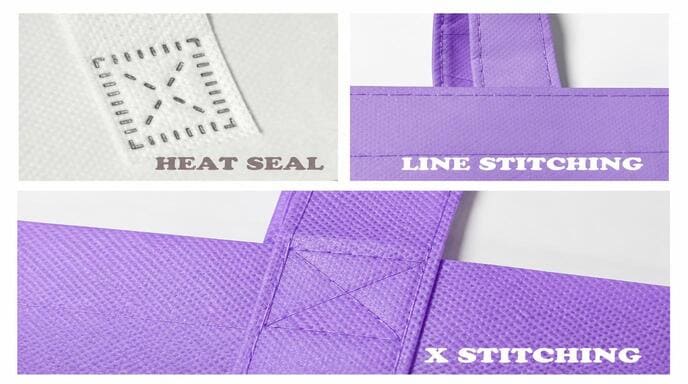
The attachment method also changes the failure mechanism. In sewn bags, the needle holes and concentrated stitching can create local stress. If the fabric is thin or the reinforcement area is too small, the fabric may pull through the stitching while the thread remains intact. In this situation, stronger thread alone may not solve the problem; the reinforcement area, stitch structure or base material may need to change.
Non-woven PP bags commonly use ultrasonic welding. Here, the effective welding area and process conditions determine how well the handle transfers the load into the bag panel. A handle can therefore be strong enough by itself while the welded connection still separates under load.
The relevant question is not simply “Is the handle strong enough?” but “Is the complete handle-to-panel connection strong enough for the material and intended load?”
Real Shopping Loads Are Dynamic and Uneven
A grocery bag is rarely subjected to a perfectly static load. A 5 kg bag produces about 49 N of gravitational force when stationary, but lifting the bag quickly, swinging it while walking, shifting the contents or placing it down abruptly can create short-duration force peaks.
Load distribution can also change during use. Bottles and cans may move to one side, a heavy item may sit directly beneath one handle, or the user may lift one handle slightly before the other. The total weight remains unchanged, but the force acting on one attachment point can increase.
This explains why a bag can survive a controlled static test but fail during actual shopping. The critical factor is not only the total load but where and how that load reaches the handle.
What Does the Location of the Tear Tell You?
The failure location is often more useful than the appearance of the broken handle itself. If the tear begins at the edge of a die-cut opening, the opening geometry, material strength and local stress should be examined. If the fabric tears around a welded handle, the welding area and surrounding material are more relevant. If the handle pulls away cleanly, the attachment strength may be insufficient. If stitching pulls through the fabric while the thread remains intact, the reinforcement area or fabric strength deserves attention.
| Failure appearance | Main areas to investigate |
|---|---|
| Tear starts at handle opening | Opening geometry, edge stress and material strength |
| Fabric tears around handle | Material strength and reinforcement |
| Handle pulls away | Attachment area and attachment strength |
| Stitching pulls through fabric | Reinforcement and fabric strength |
| Weld separates | Welding area and process conditions |
| Handle material breaks | Handle material, width and construction |
| Upper edge tears | Edge reinforcement and load distribution |
| One side fails first | Uneven loading or asymmetric construction |
This approach is more useful than automatically increasing GSM or adding more stitches. The location and direction of the tear often show which part of the load-bearing structure needs to change.
How Can Grocery Bag Handle Failure Be Prevented?
The correct solution depends on the actual failure mechanism. If the material around the handle tears, increasing material strength or reinforcement may be appropriate. If the handle pulls away, increasing the attachment area or improving the attachment process is more relevant. If the handle opening tears, the opening geometry and surrounding reinforcement should be reviewed. If stitching pulls through the fabric, the reinforcement structure may need to be changed rather than simply increasing thread strength.
The same principle applies to repeated-use bags. A static load test can show whether a bag withstands a particular load under controlled conditions, but it does not necessarily represent repeated lifting, swinging or uneven loading. Where the bag is intended for frequent reuse, durability or repeated-load testing can provide more useful information.
The goal is therefore not to make one component significantly stronger than the others. The handle, reinforcement, attachment and bag panel should form a balanced load-bearing structure.
What Should Buyers Specify When Ordering Custom Grocery Bags?
For custom production, specifying only “strong handles” leaves too much room for interpretation. A useful specification should define the material and GSM, bag dimensions, handle type and width, handle opening where applicable, attachment method, reinforcement structure, intended working load and expected reuse conditions. Where handle performance is critical, the buyer should also specify the required load or handle test and make sure the test samples use production-equivalent materials and construction.
Instead of asking for a reusable grocery bag that can “carry 10 kg,” a more measurable requirement would be:
PP non-woven reusable grocery bag with specified GSM, reinforced handle attachment, designed for a 10 kg working load, with the handle attachment tested on production-equivalent samples.
This gives the manufacturer a clearer engineering target and makes it easier to determine whether the material, handle or attachment needs adjustment.
The Main Reason Grocery Bag Handles Break
Grocery bag handles often fail first because they transfer the entire bag load through a relatively small area. This creates localized stress around the handle opening, attachment, stitching, welding or surrounding fabric. The risk becomes greater when the material is too light for the intended load, the attachment area is too small, the load is uneven or the bag is subjected to dynamic and repeated forces.
The main causes are therefore not limited to a “weak handle.” They include stress concentration, material strength, handle geometry, attachment structure, reinforcement, uneven loading and dynamic forces.
A stronger handle can help, but it is only one part of the load-bearing system. The material, handle and attachment need to work together so that the handle area does not become the weakest point of the bag.