The IKEA blue bag, known as FRAKTA, is a strong example of how a functional reusable bag can become a recognizable part of a brand.
Its identity was not built around complicated graphics or an unusual structure. It developed through practical decisions: solving a carrying problem, separating in-store and take-home bags through color, maintaining a consistent form and handle arrangement, and making the bag useful beyond the original shopping trip.
For companies developing custom reusable bags, FRAKTA is useful because its visual identity developed alongside its function rather than separately from it.
Quick Overview
- FRAKTA grew from a practical problem: how customers could carry smaller purchases more easily.
- IKEA's early yellow bag created checkout confusion, leading to a separate blue take-home bag.
- Color, proportions, handles and branding work together as a recognizable visual system.1
- Its large capacity and durability encouraged continued use beyond shopping.
- The main lesson for custom reusable bags is to combine function, a few distinctive visual elements and consistent production.
The Story Behind IKEA's Blue Bag Design
A Carrying Problem Came Before the Branding
The origins of FRAKTA can be traced to IKEA's self-service retail environment.
According to the IKEA Museum, IKEA began examining how customers carried smaller products as early as the 1960s2. By 1986, Ingvar Kamprad and his assistant Sten Lundén were looking more closely at the problem.3
Platform trolleys worked for larger purchases, but smaller products were often carried in baskets or by hand. Some baskets and bags were simply too small, and customers sometimes left products behind because carrying them was inconvenient4.
The starting question was therefore not:
“How can IKEA create an iconic bag?”
It was:
“How can customers carry more of their purchases more easily?”
That distinction is important in custom reusable bag design. Capacity, product size, carrying conditions and frequency of reuse should normally be defined before visual branding is finalized.
From the Yellow Bag to the Blue FRAKTA
The first solution was a yellow bag produced in Taiwan.5 IKEA initially used yellow bags both inside the store and for customers taking purchases home.
This created a practical problem at checkout: employees could not easily tell which bags had already been paid for and which were intended to remain in the store.
The IKEA Museum records that the first batch of yellow bags was tested at IKEA Hamburg in 19896. The checkout confusion became clear, leading IKEA to separate the two functions by color. The blue bag became the customer take-home carrier, while yellow bags remained associated with carrying products inside the store.7
This is one of the most useful parts of the FRAKTA story for bag designers: a visual distinction emerged from an operational requirement.
The blue color was not simply a decorative branding decision. It helped distinguish one use from another. Repeated exposure then strengthened its association with IKEA.
The design history therefore follows a clear sequence:
carrying problem → yellow bag → operational confusion → color separation → blue FRAKTA
That is more useful to study than simply saying that IKEA chose a memorable color.
How FRAKTA's Simple Design Became Recognizable
FRAKTA's recognition comes from several stable characteristics working together rather than from one isolated graphic element.
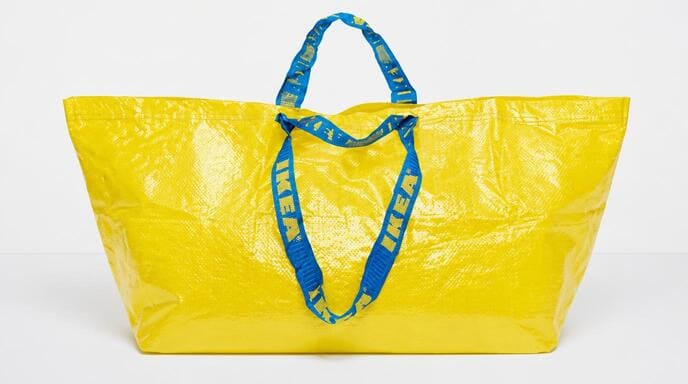
The current large FRAKTA carrier listed by IKEA measures 55 × 37 × 35 cm8, has a 71-liter capacity9, and uses 100% polypropylene with at least 90% recycled material10 on the current Japanese listing. It has both short and long handles and is described as strong, durable and spacious.
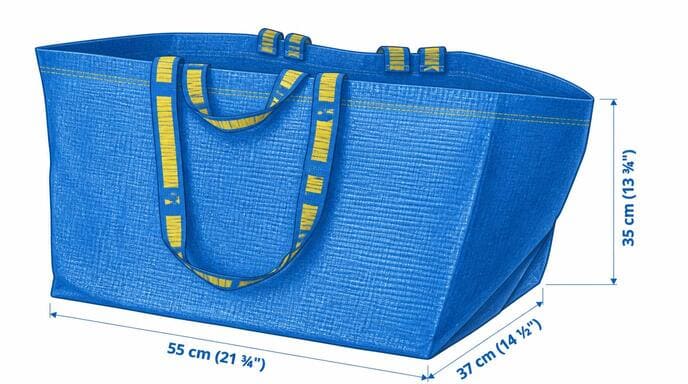
The important design elements include:
- Blue body color
- Large rectangular proportions
- Gusseted structure
- Short and long handles
- Yellow contrasting details
- Consistent graphic placement
- IKEA branding
Together, these create a physical and visual profile that can remain recognizable even when the logo is not the first thing a viewer notices.
The Simple Design Principle: Fewer Elements, Stronger Consistency
A useful principle for custom reusable bag design is:
The simpler the visual system, the more important production consistency becomes.
A bag does not need an unusual silhouette or many decorative graphics. A recognizable body color, fixed proportions and distinctive handle arrangement may be enough if they are repeated consistently.
For repeat production, these elements should become measurable specifications:
| Key element | Production consideration |
|---|---|
| Material | Material type and GSM |
| Size | Width, height, gusset and tolerance |
| Color | Body and printing color references |
| Handles | Length, width, color and position |
| Construction | Sewing, ultrasonic forming, lamination, etc. |
| Printing | Artwork position, method and coverage |
| Reinforcement | Stress points and attachment strength |
This is particularly important when the bag itself is intended to become part of the brand identity. Small changes in dimensions, handle position or color can become more noticeable when the design relies on only a few visual cues.
Why FRAKTA Became More Than a Shopping Bag
FRAKTA was created to help customers transport purchases, but its usefulness did not end at the store.
The IKEA Museum notes that the bag has been used for shopping, moving, laundry, beach trips and other purposes. IKEA's current product information similarly presents it as useful for shopping, laundry, the beach and everyday carrying, while also noting that it can be folded flat for storage.
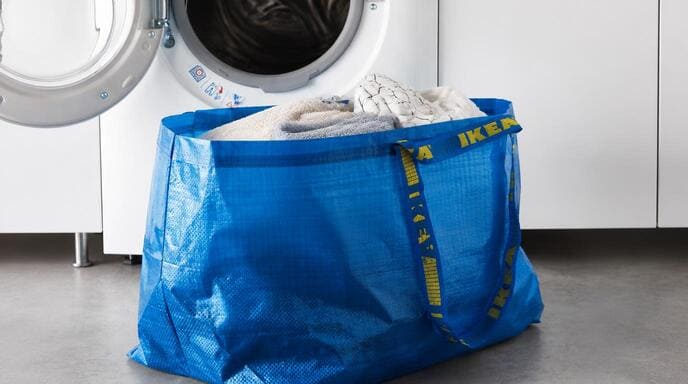
This gives the product a longer functional life:
shopping → transport → household use → repeated use
That matters for branded reusable bags because usefulness gives customers a reason to keep the product rather than treating it as a one-time promotional item11.
The important relationship is:
useful product → greater chance of retention → repeated use → more opportunities for visual exposure
Reuse does not automatically create brand recognition. But when practical value and a consistent visual identity exist together, the bag has more opportunities to remain visible in everyday life.
Can a Reusable Bag Be Recognized Without Its Logo?
This is a useful test when developing a branded reusable shopping bag.
Imagine the logo is too small to read from several meters away. Can the bag still be identified through its:
- Color?
- Shape?
- Proportions?
- Handle arrangement?
- Graphic pattern?
- Overall construction?
If not, the bag may depend mainly on printed branding.
That is perfectly reasonable for many promotional bags. But if the objective is to make the bag itself recognizable, physical characteristics need to contribute to the identity.
FRAKTA demonstrates this principle through the combination of its blue body, large profile, handles and branding.
The lesson is not to remove the logo. It is to avoid making the logo the only memorable element.
What IKEA's Bag Design Teaches Custom Bag Buyers
The FRAKTA story can be translated into a practical design process without copying its appearance.
Start With the Carrying Requirement
Ask three questions first:
What will customers carry? How much will they carry? How often will the bag be reused?
| Requirement | Design impact |
|---|---|
| Heavy load | GSM, handle strength, reinforcement |
| Large products | Width, height, gusset, capacity |
| Frequent reuse | Material durability and construction |
| Folding/storage | Structure and material flexibility |
| Retail use | Opening, comfort and appearance |
| Branding | Color, printing area and placement |
The material and structure should therefore be developed together with the artwork.
Choose a Small Number of Visual Signatures
A custom bag does not need every component to be distinctive.
Practical combinations include:
- Body color + contrasting handles
- Fixed silhouette + consistent graphic placement
- Recognizable pattern + stable proportions
- Special handle treatment + restrained branding
The objective is to create a small set of signals that can be repeated across production runs.
Treat the Bag as a Product, Not Just a Printing Surface
This is the key difference between a campaign-oriented promotional bag and a product-oriented reusable bag.
| Promotional bag | Product-oriented reusable bag |
|---|---|
| Logo is often the main identifier | Product appearance also supports recognition |
| Artwork may change by campaign | Core visual elements remain stable |
| Short-term marketing role | Designed for repeated use |
| Printing carries much of the identity | Color, shape, handles and printing work together |
Neither approach is automatically better. The question is:
Should the bag simply carry the brand, or should the bag itself become recognizable?
That decision affects material, structure, artwork and production specifications.
Turning the Design Into Production Specifications
A simple design still needs precise manufacturing requirements if it will be reordered.
A custom reusable bag specification should normally define:
- Material: type, GSM and recycled-content requirements
- Dimensions: finished width, height, gusset and tolerances
- Color: body and printing references
- Handles: material, length, width, color, position and attachment
- Printing: method, artwork placement and coverage
- Construction: sewing, ultrasonic forming, lamination or other required process
- Quality control: key appearance and structural points checked before shipment
The purpose is not to reproduce FRAKTA. It is to make the chosen characteristics of a custom bag repeatable from one production order to the next.
How to Apply the IKEA Design Logic to a Custom Reusable Bag
A practical development sequence is:
- Define the use case — determine what the customer will carry and how the bag will be reused.
- Select material and structure — match material, GSM, dimensions and construction to the application.
- Choose the visual signature — identify the few characteristics customers should remember.
- Develop artwork around the structure — make the graphics work with the physical bag.
- Create production specifications — document material, dimensions, color, handles, printing and construction.
- Keep core elements stable — avoid unnecessary changes when long-term recognition matters.
The underlying logic is:
solve a real use problem → establish a simple visual system → make the product useful enough to keep → define key specifications → reproduce them consistently
The Real Lesson From IKEA's Blue Bag
FRAKTA is valuable as a design case because its history is rooted in practical retail requirements.
Customers needed a better way to carry smaller purchases. IKEA developed yellow bags, but using the same color for different purposes created checkout confusion. The 1989 Hamburg test exposed the problem, and the blue take-home FRAKTA emerged as the solution.
Its later recognition is therefore better understood as the result of several factors working together:
functional purpose + consistent structure + distinctive visual cues + continued use + production consistency
For companies developing custom reusable bags, the better question is not:
“How can we put more design on the bag?”
It is:
“Which few characteristics should customers remember, why will they keep using the bag, and can those characteristics be reproduced consistently?”
That is where a functional reusable bag can begin to become a recognizable part of a brand.
FAQ
Why did IKEA change its bag from yellow to blue?
IKEA initially used yellow bags for both in-store carrying and customers taking purchases home. This created confusion at checkout. The blue bag was introduced as the customer take-home carrier, while yellow remained associated with in-store use.
When was the IKEA FRAKTA bag developed?
The development history goes back to IKEA's efforts to improve how customers carried smaller purchases. Ingvar Kamprad and Sten Lundén examined the problem in 1986, while the first yellow-bag batch was tested in Hamburg in 1989. The checkout problem then led to the blue FRAKTA.
Why is the IKEA blue bag so recognizable?
Its recognition comes from a combination of stable characteristics: blue color, large rectangular proportions, handle arrangement, yellow details and IKEA branding. Continued practical use has also kept the design visible beyond the store.
What material is the IKEA FRAKTA bag made from?
The current large FRAKTA carrier listed by IKEA Japan is made from 100% polypropylene, with at least 90% recycled material. Different FRAKTA products or versions may have different specifications, so current product information should be checked for a specific model.
What can companies learn from IKEA's bag design?
The main lesson is to connect function and visual identity. A custom reusable bag can become more recognizable when a small number of characteristics—such as color, proportions, handles and graphic placement—remain consistent across production runs.
How can a custom reusable bag become recognizable?
Start with the intended use, then define the material, structure and dimensions. Choose a small number of visual signatures, develop the artwork around the physical bag, and convert the final design into clear production specifications. The goal is not more graphics, but memorable design elements that can be reproduced consistently.
-
"Exploring the strategic value of brand's iconic colour", https://bioresources.cnr.ncsu.edu/resources/colour-and-furniture-brand-identity-exploring-the-strategic-value-of-brands-iconic-colour/. Research on brand identity and distinctive brand assets describes how non-name elements such as colors, shapes, and other visual cues can contribute to brand recognition when used consistently. Evidence role: expert_consensus; source type: paper. Supports: Color, proportions, handles, and branding can work together as a recognizable visual system.. Scope note: Such research supports the general branding mechanism rather than empirically testing FRAKTA’s specific recognition. ↩
-
"The story of a beloved IKEA bag", https://ikeamuseum.com/en/explore/the-story-of-ikea/beloved-bag/. The IKEA Museum’s account of FRAKTA’s development documents that IKEA had considered customer carrying methods for smaller goods from the 1960s, providing historical context for the bag’s functional origins. Evidence role: historical_context; source type: institution. Supports: IKEA began examining how customers carried smaller products as early as the 1960s.. Scope note: This is institutional history from IKEA’s museum rather than an independent archival study. ↩
-
"The story of a beloved IKEA bag", https://ikeamuseum.com/en/explore/the-story-of-ikea/beloved-bag/. The IKEA Museum identifies Ingvar Kamprad and Sten Lundén as involved in revisiting the customer-carrying problem in 1986, supporting the article’s chronology of FRAKTA’s development. Evidence role: historical_context; source type: institution. Supports: Ingvar Kamprad and Sten Lundén examined the carrying problem in 1986.. Scope note: The source supports IKEA’s internal development narrative but does not independently evaluate the design process. ↩
-
"The story of a beloved IKEA bag", https://ikeamuseum.com/en/explore/the-story-of-ikea/beloved-bag/. The IKEA Museum’s history of the FRAKTA bag describes customer carrying limitations as a practical retail problem, including cases in which customers could not conveniently carry all intended purchases. Evidence role: case_reference; source type: institution. Supports: Customers sometimes left products behind because carrying them was inconvenient.. Scope note: The evidence is qualitative and historical; it does not quantify how often customers abandoned products for this reason. ↩
-
"The story of a beloved IKEA bag", https://ikeamuseum.com/en/explore/the-story-of-ikea/beloved-bag/. The IKEA Museum’s account states that an early yellow carrier bag was produced in Taiwan, supporting the claim about FRAKTA’s predecessor and production origin. Evidence role: historical_context; source type: institution. Supports: The first solution before the blue FRAKTA was a yellow bag produced in Taiwan.. Scope note: This supports the specific historical detail as reported by IKEA’s museum, not a broader manufacturing analysis. ↩
-
"The story of a beloved IKEA bag", https://ikeamuseum.com/en/explore/the-story-of-ikea/beloved-bag/. The IKEA Museum records that the first batch of yellow bags was tested at IKEA Hamburg in 1989, supporting the article’s account of the trial that preceded the blue take-home bag. Evidence role: historical_context; source type: institution. Supports: The first batch of yellow bags was tested at IKEA Hamburg in 1989.. Scope note: The citation establishes the test location and year but does not by itself measure the test’s operational outcomes. ↩
-
"The story of a beloved IKEA bag", https://ikeamuseum.com/en/explore/the-story-of-ikea/beloved-bag/. The IKEA Museum explains that IKEA separated bag functions by color after checkout confusion, with blue used for customer take-home bags and yellow retained for in-store carrying. Evidence role: case_reference; source type: institution. Supports: IKEA used blue bags for customer take-home use and yellow bags for in-store carrying after checkout confusion.. Scope note: The source documents IKEA’s case specifically and should not be treated as evidence that color separation works identically in all retail contexts. ↩
-
"FRAKTA shopping bag, large, blue, 21 ¾x14 ½x13 ¾"/19 gallon - IKEA", https://www.ikea.com/us/en/p/frakta-shopping-bag-large-blue-20611108/. IKEA’s product information for the large FRAKTA carrier lists the dimensions as 55 × 37 × 35 cm, supporting the article’s specification of the current model’s size. Evidence role: definition; source type: other. Supports: The current large FRAKTA carrier is listed with dimensions of 55 × 37 × 35 cm.. Scope note: Product specifications may vary by market, model, or date; the citation applies to the listed FRAKTA carrier version. ↩
-
"FRAKTA carrier bag, large, blue, 55x37x35 cm/71 l - IKEA Estonia", https://www.ikea.com/ee/en/p/frakta-carrier-bag-large-blue-20611108/. IKEA’s product listing for the large FRAKTA carrier gives a volume of 71 liters, supporting the article’s statement about the bag’s capacity. Evidence role: definition; source type: other. Supports: The current large FRAKTA carrier has a 71-liter capacity.. Scope note: The figure supports the specified large carrier model and may not apply to other FRAKTA sizes or regional variants. ↩
-
"Frakta", https://en.wikipedia.org/wiki/Frakta. IKEA’s current product information for the large FRAKTA carrier describes the material as 100% polypropylene and states that it contains at least 90% recycled content. Evidence role: definition; source type: other. Supports: The current large FRAKTA carrier is made from 100% polypropylene with at least 90% recycled material.. Scope note: This supports the current listed product specification and may not describe earlier FRAKTA versions or all market listings. ↩
-
"Consumers' Intention to Bring a Reusable Bag for Shopping in ...", https://pmc.ncbi.nlm.nih.gov/articles/PMC8955543/. Studies of reusable shopping bag behavior identify perceived usefulness, convenience, and habit as factors associated with continued use, supporting the general claim that practical value can encourage retention. Evidence role: general_support; source type: paper. Supports: Usefulness gives customers a reason to keep and reuse a reusable bag rather than discard it after one use.. Scope note: The evidence concerns consumer reuse behavior generally and does not directly measure retention of branded promotional bags. ↩