Choosing coffee packaging is not simply a matter of selecting a bag that fits 250 g, 500 g, or 1 kg of coffee. The right format depends on what you sell, how the coffee is processed, how long it needs to remain fresh, where it is sold, and how customers use the package after opening.
A coffee roaster selling freshly roasted whole beans through an online store has different packaging requirements from a wholesaler shipping 5 kg of ground coffee to cafés. Retail products also need to balance shelf appearance and resealability, while e-commerce packaging must tolerate handling and transportation.
The practical question is therefore:
Which coffee packaging format, material structure, size, and closure system provide enough protection without adding unnecessary packaging cost?
Key Takeaways
- Whole beans generally require strong oxygen, moisture, light, and aroma protection, while allowing CO₂ to escape after roasting.
- Ground coffee has a much larger exposed surface area than whole beans, so oxygen protection becomes particularly important.
- Drip coffee is normally packed in individual filter sachets and requires high-barrier protection because each portion has a relatively large package surface area compared with its coffee mass.
- Flexible multilayer barrier packaging is widely used for roasted coffee because it can combine oxygen, moisture, light, and aroma protection with relatively low packaging weight.
- A one-way degassing valve can be useful for freshly roasted coffee when CO₂ generation after packing is expected.
- Retail, wholesale, and e-commerce do not automatically require completely different packaging materials; they mainly change the required size, closure, appearance, durability, and cost structure.
- Package dimensions should be confirmed using the actual coffee fill weight, bulk density, bag construction, and filling process.
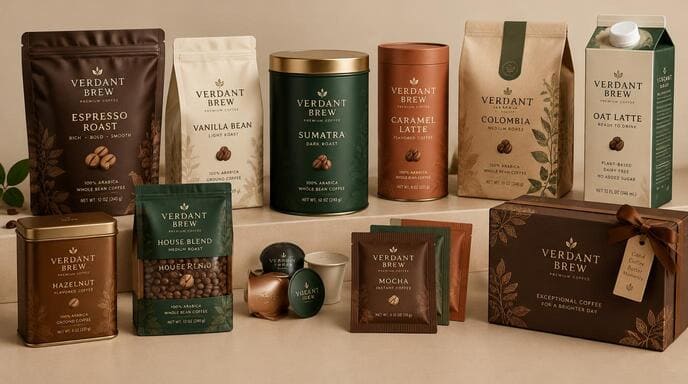
- For brands with strong visual identity, the outer bag is also a branding medium, not only a container. Material, shape, printing, and finishing can be selected to support the intended brand image.
How Should Coffee Beans, Ground Coffee, and Drip Coffee Be Packaged?
The first decision should be based on the physical form of the coffee.
Whole Coffee Beans
Whole beans are relatively easy to package compared with ground coffee because grinding greatly increases the coffee's exposed surface area. However, freshly roasted beans continue to release CO₂ after roasting.
This creates a packaging requirement that is slightly different from ordinary dry-food packaging: the package needs to prevent external oxygen and moisture from entering while allowing excess CO₂ to escape.
A one-way degassing valve is therefore commonly used on bags for freshly roasted whole beans. The valve allows internal gas to exit while limiting the entry of outside air. Research summarized by the Specialty Coffee Association indicates that CO₂ can account for a very high proportion of the gas inside a valve bag during the first week after roasting.
For a typical retail whole-bean product:
| Product | Common starting fill size | Packaging features to consider |
|---|---|---|
| Specialty coffee | 250 g | High barrier, valve, resealable zipper |
| Standard retail coffee | 500 g | High barrier, valve, zipper or tin tie |
| Family/large pack | 1 kg | Stronger seal, high barrier, valve |
| Foodservice | 1–5 kg | Heavy-duty barrier structure, heat seal; valve depending on roast and filling method |
These are starting points rather than universal specifications. Actual dimensions should be confirmed using the coffee's bulk density and the intended filling process.
Ground Coffee
Ground coffee generally requires more careful oxygen control than whole beans because grinding increases the exposed surface area.
A high-barrier multilayer package can still be appropriate, but the importance of residual oxygen, sealing integrity, and storage conditions becomes greater.
Research summarized by the Specialty Coffee Association reported that reducing oxygen inside a coffee container to around 0.5% was associated with up to a 20-fold increase in shelf life in one study.
For ground coffee, consider:
- High oxygen-barrier material
- Good moisture barrier
- Reliable heat sealing
- Nitrogen flushing or vacuum packaging where appropriate
- Resealable closure for consumer packs
- Light protection when required by the product and distribution conditions
Nitrogen flushing can help reduce oxygen exposure, but it cannot compensate for inadequate sealing or unsuitable barrier material.
Drip Coffee
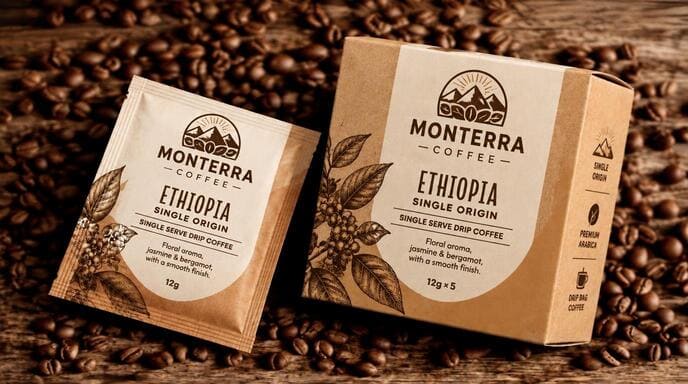
Drip coffee is usually packaged as individual single-serve filter sachets, often placed inside an outer carton or pouch.
The individual sachet protects a relatively small quantity of ground coffee for a defined period, making oxygen and moisture barrier performance particularly important.
For example, a brand selling 10 individual drip bags effectively has two packaging levels:
- The individual sachet that protects each coffee portion.
- The outer package that provides secondary protection, branding, and retail presentation.
Because drip coffee is already ground, high-barrier film is normally more important than simply increasing film thickness.
How Do Retail, Wholesale, and E-Commerce Packaging Requirements Differ?
The same coffee can use similar basic barrier technology across different sales channels, but the priorities change.
Retail Packaging
Retail coffee packaging has to perform two jobs simultaneously: protect the coffee and present the product on the shelf.
Typical requirements include:
- 250 g, 340 g, 500 g, or 1 kg formats
- Strong visual printing
- Resealable closure for repeated use
- Degassing valve where appropriate
- Stable shelf presentation
- Easy opening
- Sufficient barrier performance for the intended shelf life
For premium coffee, packaging design may also become part of the product's positioning. However, decorative finishes do not necessarily improve coffee protection, so visual decisions and technical requirements should be evaluated separately.
Wholesale Packaging
Wholesale buyers generally place greater emphasis on cost per kilogram, filling efficiency, handling, strength, and transportation.
A café supplier, for example, may use 1 kg retail-style bags for resale but larger 2–5 kg formats for foodservice.
If the coffee is delivered directly to commercial customers and consumed relatively quickly, investing heavily in cosmetic features may provide less value than improving package strength, sealing reliability, and packing efficiency.
E-Commerce Packaging
E-commerce introduces additional physical handling. The coffee may pass through multiple sorting and transportation stages before reaching the customer.
The package therefore needs to tolerate:
- Repeated handling
- Compression
- Friction
- Parcel sorting
- Temperature fluctuations
- Longer distribution routes
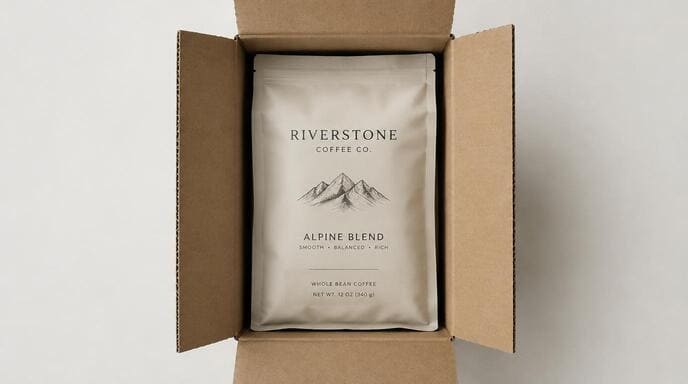
The coffee bag and the secondary shipping package should also be considered separately. The coffee bag protects and presents the product, while the outer carton or mailer provides additional protection during shipping.
How Do You Choose the Right Coffee Packaging Material?
Coffee packaging materials should be selected according to the barrier properties actually required rather than simply choosing the thickest film.
The main packaging functions are:
Oxygen barrier + moisture barrier + light protection + mechanical strength + sealing performance
Flexible coffee packaging often uses multilayer structures because different layers can provide different functions.
A typical high-barrier structure may combine:
- PET: printing surface, stiffness, and dimensional stability
- Aluminum foil or metallized layer: oxygen, moisture, and light barrier
- PE or CPP: heat-sealing layer and food-contact functionality
Aluminum-containing structures have historically been widely used for roasted and ground coffee because they provide strong barrier performance.
However, aluminum foil is not automatically required for every coffee product. Alternative multilayer films can also be designed according to the required barrier, sustainability objectives, appearance, and cost.
Therefore, material selection should consider:
| Requirement | What to evaluate |
|---|---|
| Oxygen protection | OTR / oxygen barrier performance |
| Moisture protection | WVTR / water-vapor barrier |
| Light protection | Opaque, metallized, or foil structure |
| Sealing | Heat-seal temperature and seal strength |
| Appearance | Gloss, matte, transparency, printing |
| Sustainability | Recyclability and material structure |
| Distribution | Puncture, abrasion, compression resistance |
| Cost | Material + converting + filling efficiency |
The important point is that material thickness alone does not determine packaging performance.
How Do You Choose the Right Coffee Packaging Size?
Coffee packaging should be sized according to fill weight, coffee density, bag geometry, and filling requirements.
A 500 g bag for whole beans cannot automatically use the same dimensions as a 500 g bag for ground coffee because bulk density can differ.
A practical development process is:
Target weight → measure bulk density → estimate required volume → determine bag dimensions → make a sample → filling test → final specification
Common commercial starting points include:
- 125–250 g: sampling, specialty coffee, premium retail
- 340–500 g: mainstream retail and specialty retail
- 1 kg: retail, cafés, and foodservice
- 2–5 kg: commercial or wholesale applications
There is no universal "correct" size. The final choice should reflect consumption rate, shelf-life target, logistics cost, storage conditions, and customer usage.
For example, a 1 kg package may reduce packaging and handling cost per kilogram, while smaller packs may be more practical when consumers use coffee slowly after opening.
Which Closure Should You Choose?
The closure affects both product protection and user experience.
Heat Seal
Heat sealing is the basic closure for many coffee packages. A properly controlled heat seal can provide a reliable hermetic closure.
Temperature, pressure, dwell time, sealing-layer material, and seal contamination can all affect the final seal.
Zipper
A zipper is useful for consumer packs that are opened repeatedly.
For example, a 500 g retail bag may be opened several times after purchase. A resealable zipper can make repeated use more convenient and reduce unnecessary exposure after opening.
However, the zipper does not replace the original factory heat seal.
Degassing Valve
A valve is particularly relevant to freshly roasted coffee.
Its function is to manage gas generated by roasted coffee while limiting outside air entering the package. It does not independently extend shelf life; its value depends on the roasting, packing, distribution, and storage conditions.
The SCA notes that coffee degassing is particularly rapid during roughly the first 20 days after roasting, although the exact rate varies with roast and storage conditions.
When the Coffee Is Sold in a Bag: How Should You Choose the Bag for Your Brand?
At this point, the question changes slightly.
The previous sections focus on how to protect and package the coffee itself. But once a brand decides to sell its coffee in a flexible bag, the bag also becomes part of the customer's first impression of the product.
For some brands, the bag is simply a functional container. For others, it is an important part of the brand identity, shelf presence, and customer experience.
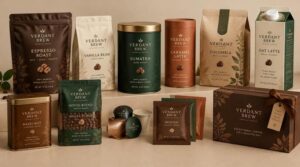
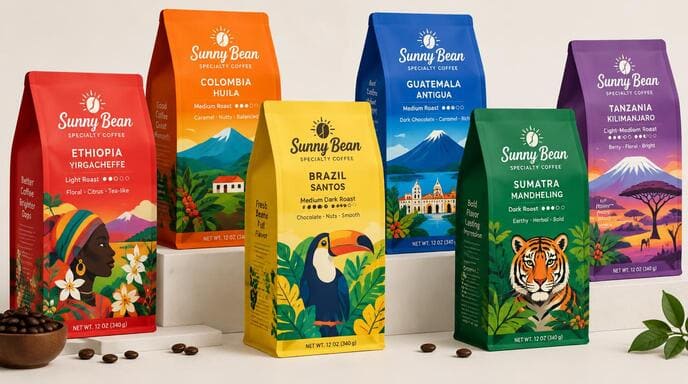
If your brand relies heavily on visual recognition or wants the package itself to communicate the brand, a custom-printed coffee bag can provide more control over colors, graphics, typography, product information, and overall appearance than a generic stock bag with a separate label.
Different Materials Can Support Different Brand Positions
There is no single material that is automatically "premium." The appropriate structure depends on the visual identity, functional requirements, sustainability goals, sales channel, and target price of the coffee.
| Bag material / finish | Typical brand positioning | Why a brand may choose it |
|---|---|---|
| Matte laminated bag | Specialty, modern, minimalist | Soft visual appearance and good print presentation |
| Gloss laminated bag | Mainstream, commercial, colorful brands | Brighter colors and stronger visual impact |
| Kraft-look bag | Natural, artisanal, organic-style brands | Communicates a paper-like or natural visual identity |
| Foil / metallized structure | Premium or protection-focused products | Strong barrier combined with metallic visual effects |
| Recyclable mono-material structure | Sustainability-focused brands | Supports brands prioritizing simplified material structures |
| Transparent window structure | Small-batch, artisan, visual-product brands | Allows the product itself to become part of the presentation |
These categories are not absolute. A premium coffee brand may use kraft-look packaging, while a mainstream brand may use a matte structure. The material should follow the brand strategy rather than determine it.
Custom Printing Can Turn the Bag Into a Brand Touchpoint
For brands that want the packaging to be recognizable beyond the product itself, customization can extend beyond simply printing a logo.
A custom bag can incorporate:
- Brand colors
- Logo and typography
- Origin information
- Roast profile
- Brewing recommendations
- Product illustrations
- Certifications or sustainability information
- QR codes
- Batch or traceability information
- Different designs for different coffee varieties
This becomes particularly relevant when the coffee is sold through specialty retail, cafés, subscription services, online stores, or gift channels, where the package may be photographed, displayed, carried, or shared on social media.
In this situation, the bag is no longer only a protective layer around the coffee. It becomes a physical brand touchpoint.
Does Every Coffee Brand Need a Custom Bag?
Not necessarily.
A small roaster testing a new product may prefer a stock bag with a label because it requires less initial investment and provides greater flexibility when product designs change.
A growing brand with stable product lines may benefit more from custom printing because the packaging itself can reinforce brand recognition.
A useful way to think about the decision is:
Stock bag + label → lower initial commitment
Custom printed bag → greater control over brand presentation
Custom material + structure + finishing → greater control over the complete packaging experience
The right choice depends on expected volume, product positioning, design requirements, and how important packaging is to customer acquisition and brand recognition.
Expert Manufacturer Analysis: Turning a Packaging Concept Into a Production-Ready Bag
From a manufacturing perspective, the final bag should not be specified only by its artwork.
A production-ready coffee bag needs to connect brand requirements with manufacturing requirements.
For example, a brand may have a specific visual concept but still need to decide:
- Which bag structure can achieve the desired shape
- Which material can reproduce the intended appearance
- Whether the design requires matte, gloss, metallic, or kraft-look effects
- Whether the bag needs a zipper or valve
- What fill weight the dimensions need to accommodate
- How many designs will be produced
- Whether different SKUs will share the same bag structure
- What order quantity makes the customized solution commercially practical
For brands developing several coffee products, standardizing the bag structure and dimensions while changing the printed artwork can sometimes simplify production and inventory management.
For a new product, it is also practical to test a physical sample before mass production. The sample can be checked for fill capacity, appearance, standing stability, opening, sealing, and overall brand presentation.
The manufacturer's role is therefore not simply to reproduce artwork. The useful part of the process is translating the brand's requirements into a bag that can be produced consistently at the required quantity, specification, and cost.
Conclusion: Choose the Coffee Packaging First, Then Make the Bag Part of the Brand
Choosing coffee packaging starts with the product itself: whole beans, ground coffee, or drip coffee, followed by shelf-life requirements, distribution conditions, package size, barrier performance, and closure.
But for brands selling coffee in flexible bags, there is a second decision that is easy to overlook: what role should the bag play in the brand?
If packaging is mainly a functional requirement, a standard bag with appropriate labeling may be sufficient. If the brand depends on strong visual recognition, premium presentation, or packaging-led communication, a custom printed bag can make the package itself part of the marketing and customer experience.
The material does not need to be the most expensive option. A matte, glossy, kraft-look, metallized, foil, or recyclable structure can each be appropriate for different brand strategies. The better approach is to match material, bag format, printing, and finishing with the brand's positioning and practical requirements.
For coffee brands that are ready to move from a packaging concept to a custom-made coffee bag, JiaRong Packaging can support the process from bag structure and material selection to custom printing, dimensions, zipper and valve options, sampling, and bulk production. This allows the final bag to be developed around both the coffee product and the brand identity, rather than treating them as separate decisions.