For many people, an insulated bag appears simple: an outer fabric layer, a shiny silver interior, and a zipper or closure. However, the actual working principle behind an insulated bag is much more scientific than its appearance suggests.
For importers, wholesalers, retailers, and brands purchasing insulated bags in bulk, the important question is not only “what does the bag look like?” but “why can some insulated bags keep products cold or warm longer while others fail under similar conditions?”
An insulated bag does not create cold or heat by itself. Instead, it slows down the movement of heat between the inside of the bag and the surrounding environment. Its performance depends on a complete thermal protection system, including insulation materials, reflective layers, closure design, bag structure, and manufacturing consistency.
The most effective insulated bags combine multiple functions: insulation materials reduce heat transfer, aluminum foil layers reflect radiant heat, closures reduce air exchange, and proper construction prevents weak points.
This is why insulated bags are widely used for frozen food, grocery delivery, beverages, meal transportation, catering services, and other temperature-sensitive applications.
Key Points You Should Know About How Insulated Bags Work
Before choosing an insulated bag, buyers should understand several important principles:
- An insulated bag maintains the existing temperature of products; it does not actively cool or heat them.
- Thermal performance depends on the complete insulation structure, not simply the presence of a shiny aluminum foil layer.
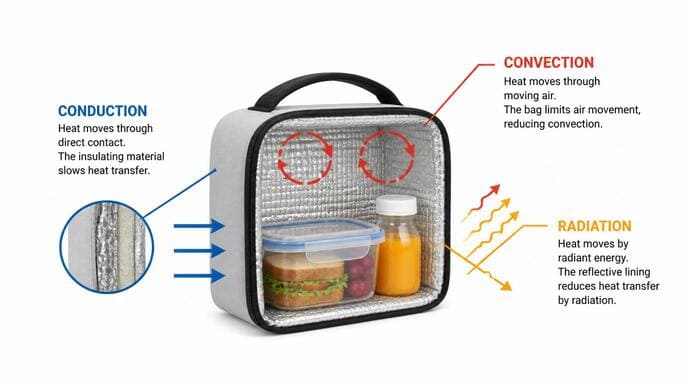
- Heat transfer happens through conduction, convection, and radiation, and good designs control all three.
- Insulation thickness alone does not determine performance. Material density, layer combination, and manufacturing quality are equally important.
- The weakest part of an insulated bag is often the opening area, because poor sealing allows faster air exchange.
- Different applications require different structures. A grocery shopping bag, food delivery bag, and commercial cooler bag may need completely different insulation designs.
Understanding these factors helps businesses avoid a common purchasing mistake: choosing an insulated bag based only on appearance, material claims, or the lowest quotation.
Why Do Insulated Bags Keep Products Cold or Warm?
When people place frozen food inside an insulated bag and notice that it remains frozen longer, or when hot meals stay warm during delivery, it may seem like the bag is “creating temperature protection.”
However, an insulated bag does not produce cooling or heating energy.
Instead, it creates resistance against natural heat movement.
Heat always moves from a warmer area toward a colder area. This basic physical principle explains why temperature changes happen:
- A cold beverage absorbs heat from a warm environment.
- Frozen products gradually lose their low temperature when exposed to surrounding heat.
- Hot food releases heat into cooler surroundings.
An insulated bag slows this exchange process.
For example, if frozen products are placed in a normal fabric bag, heat from the outside environment can quickly pass through the bag wall. In an insulated bag, specially designed materials create barriers that slow this movement.
The same principle applies to hot food. A food delivery bag does not add heat to meals. Instead, it reduces how quickly heat escapes from the food container.
This difference is important because it changes how buyers evaluate insulated bags.
A common misunderstanding is:
“Does this bag make products colder?”
The correct question is:
“How effectively does this bag slow temperature change?”
This is why insulated bags are used in many industries:
| Application | Why insulated bags are used |
|---|---|
| Grocery retail | Helps maintain frozen and chilled products during short transportation |
| Food delivery | Reduces heat loss or heat gain during delivery |
| Beverage brands | Provides reusable cooling solutions and promotional value |
| Catering | Supports short-term food transportation |
| Temperature-sensitive products | Provides additional thermal protection during handling |
However, different applications have different requirements.
A reusable grocery bag may only need to maintain temperature during a short shopping trip. A professional food delivery bag may need stronger insulation because it is opened frequently and exposed to outdoor conditions.
Therefore, a high-performance insulated bag is not simply a thicker version of a normal bag. It is an engineered structure designed around a specific usage environment.
How Heat Transfer Affects Insulated Bag Performance
To understand why insulated bags work, it is necessary to understand how heat moves.
Heat transfer occurs mainly through three methods:
- Conduction
- Convection
- Radiation
Every insulated bag design interacts with these three processes.
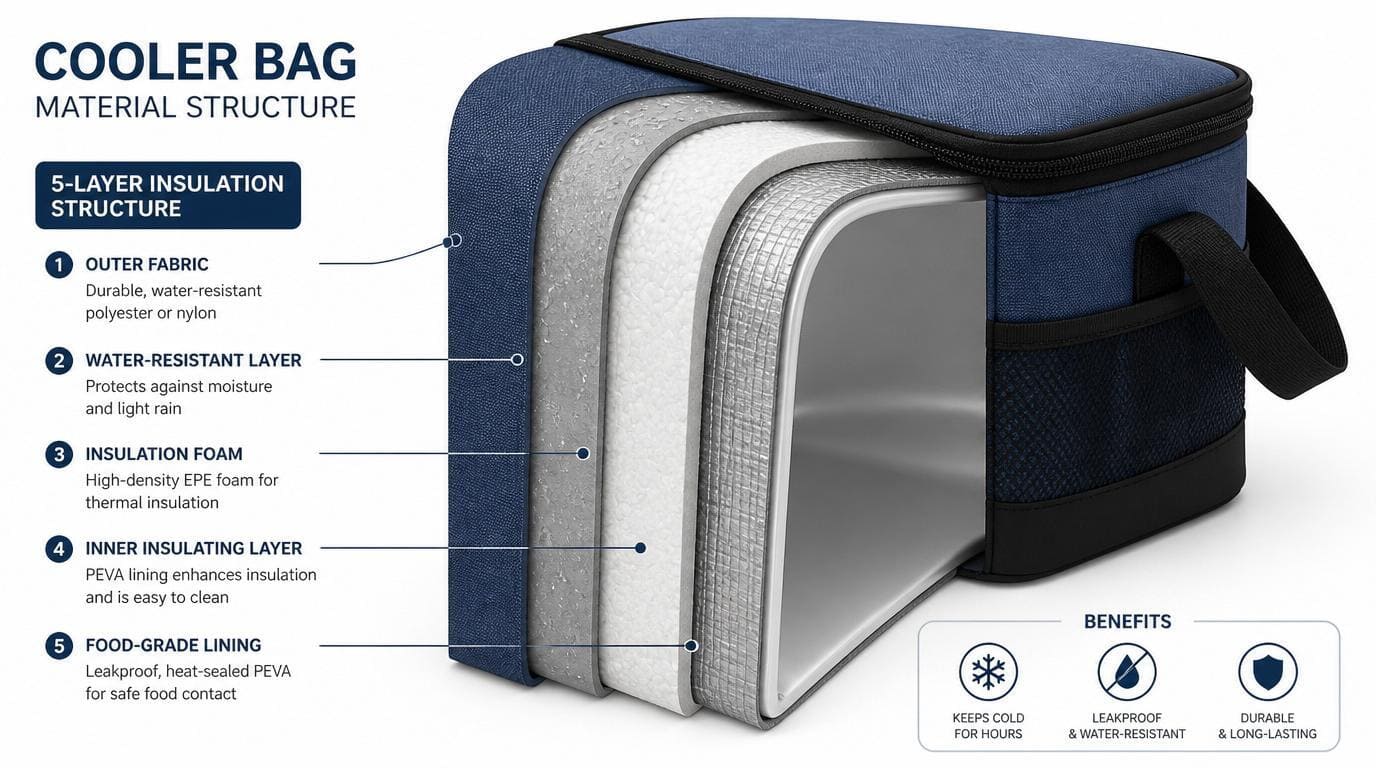
A professional insulation structure does not rely on one single material. Instead, different layers perform different functions.
For example:
- The insulation layer reduces direct heat movement through materials.
- The reflective aluminum layer reduces radiant heat.
- The closure system limits air exchange.
- The outer fabric protects the structure and improves durability.
When these components work together, the bag can slow temperature changes more effectively.
This explains why two insulated bags with almost identical appearances can perform very differently.
One bag may contain:
- Low-density insulation material
- Weak lamination
- Poor sealing
- Uneven thickness
Another may contain:
- Stable insulation density
- Proper layer bonding
- Better closure design
- Consistent manufacturing control
Although both may have a silver interior and similar dimensions, their real performance can be significantly different.
For B2B buyers, this is one of the most important concepts when sourcing custom insulated bags.
The visible appearance only shows the outside. The thermal structure inside determines the actual performance.
How Insulated Bags Reduce Heat Transfer Through Conduction
Conduction is the transfer of heat through direct contact between materials.
In daily life, conduction can be easily observed:
- A metal spoon becomes hot when placed in hot water.
- Ice melts faster when placed directly on a warm surface.
- A cold product slowly warms when exposed to a hotter surrounding material.
In an insulated bag, conduction occurs when heat moves from the outside environment through the bag structure toward the products inside.
The main purpose of insulation materials is to slow this movement.
Common insulation materials include:
- EPE pearl cotton
- Closed-cell foam
- Foam laminated layers
- Multi-layer insulation materials
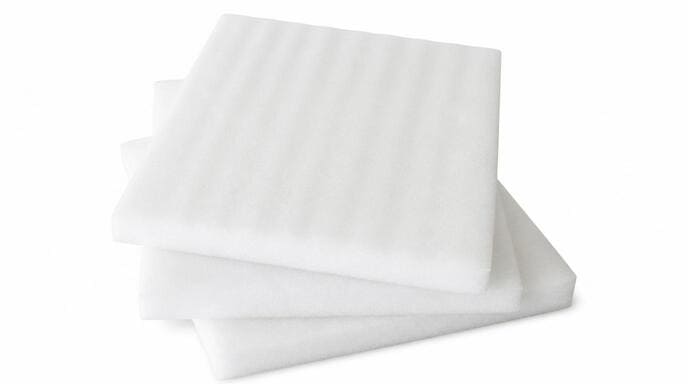
These materials work because their internal structures reduce the efficiency of heat transfer.
EPE pearl cotton is widely used in reusable insulated bags because it provides several practical advantages:
- Lightweight structure
- Flexible processing
- Moisture resistance
- Cushioning protection
- Suitable thermal resistance
Its closed-cell structure contains small air spaces that help reduce direct heat movement.
However, many buyers make a common mistake when evaluating insulation:
They only compare thickness.
For example:
“Bag A has thicker insulation, so it must perform better.”
This assumption is not always correct.
A thicker insulation layer may perform poorly if:
- The material density is low.
- The insulation thickness is inconsistent.
- The internal structure contains weak areas.
- The manufacturing process creates gaps between layers.
A thinner but higher-density insulation layer can sometimes provide better results than a thicker low-quality material.
For manufacturers, controlling insulation quality requires attention to:
- Material density
- Thickness consistency
- Lamination quality
- Layer positioning
- Production stability
This is especially important for bulk orders because a sample may look excellent, but thousands of units must maintain the same structure during mass production.
For buyers, asking only:
“What is the insulation thickness?”
is usually not enough.
More useful questions include:
- What insulation material is used?
- What is the material density?
- How consistent is the insulation layer during production?
- How are different layers bonded together?
How Insulated Bags Reduce Heat Transfer Through Convection
Convection is heat transfer caused by the movement of air.
Unlike conduction, which happens through materials, convection happens through air circulation.
Inside an insulated bag, uncontrolled air movement can accelerate temperature changes.
For example:
A cold product placed inside a poorly sealed bag allows warm outside air to enter continuously. Even if the insulation material itself is acceptable, constant air exchange reduces the overall performance.
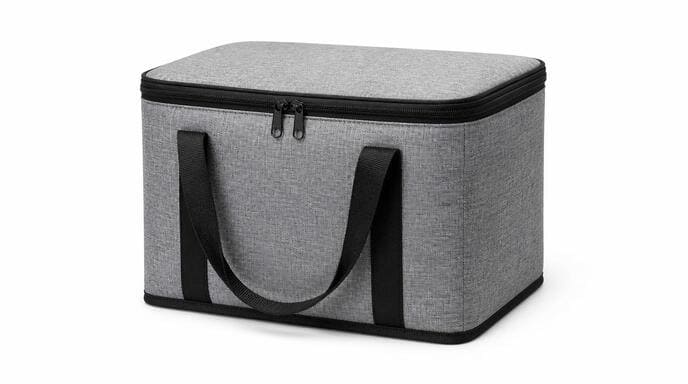
This is why closure design is a critical part of insulated bag engineering.
Common closure systems include:
- Zippers
- Roll-top closures
- Fold-over designs
- Heat-sealed structures
Each design has different advantages depending on usage.
A grocery cooler bag may use a simple zipper because it is opened occasionally.
A commercial food delivery bag may require stronger sealing because delivery workers open the bag many times throughout the day.
The opening area is often the weakest point of an insulated bag because it creates the largest opportunity for air exchange.
Even a high-quality insulation layer cannot fully compensate for poor closure performance.
Other factors affecting convection include internal space.
An oversized insulated bag carrying only a small amount of product contains more empty air volume.
When the bag opens:
- Warm outside air enters.
- Conditioned internal air escapes.
- The temperature changes faster.
Proper sizing helps reduce unnecessary air movement.
This is why professional buyers should consider the relationship between:
- Product volume
- Bag capacity
- Opening frequency
- Transportation time
A well-designed insulated bag is not simply a container with insulation material. It is a controlled environment designed to reduce heat exchange.
How Insulated Bags Reduce Heat Transfer Through Radiation
Radiation is the third major way heat moves and plays an important role in insulated bag performance, especially when products are exposed to sunlight, warm vehicles, or outdoor environments.
Unlike conduction and convection, radiation does not require direct contact between materials or movement of air.
A simple example is sunlight.
A product placed under direct sunlight can become warmer even without touching a hot object. This happens because infrared radiation transfers energy from the sun to the product surface.
Inside an insulated bag, radiant heat from the external environment can affect the temperature of products. This is where reflective materials, especially aluminum foil layers, become useful.
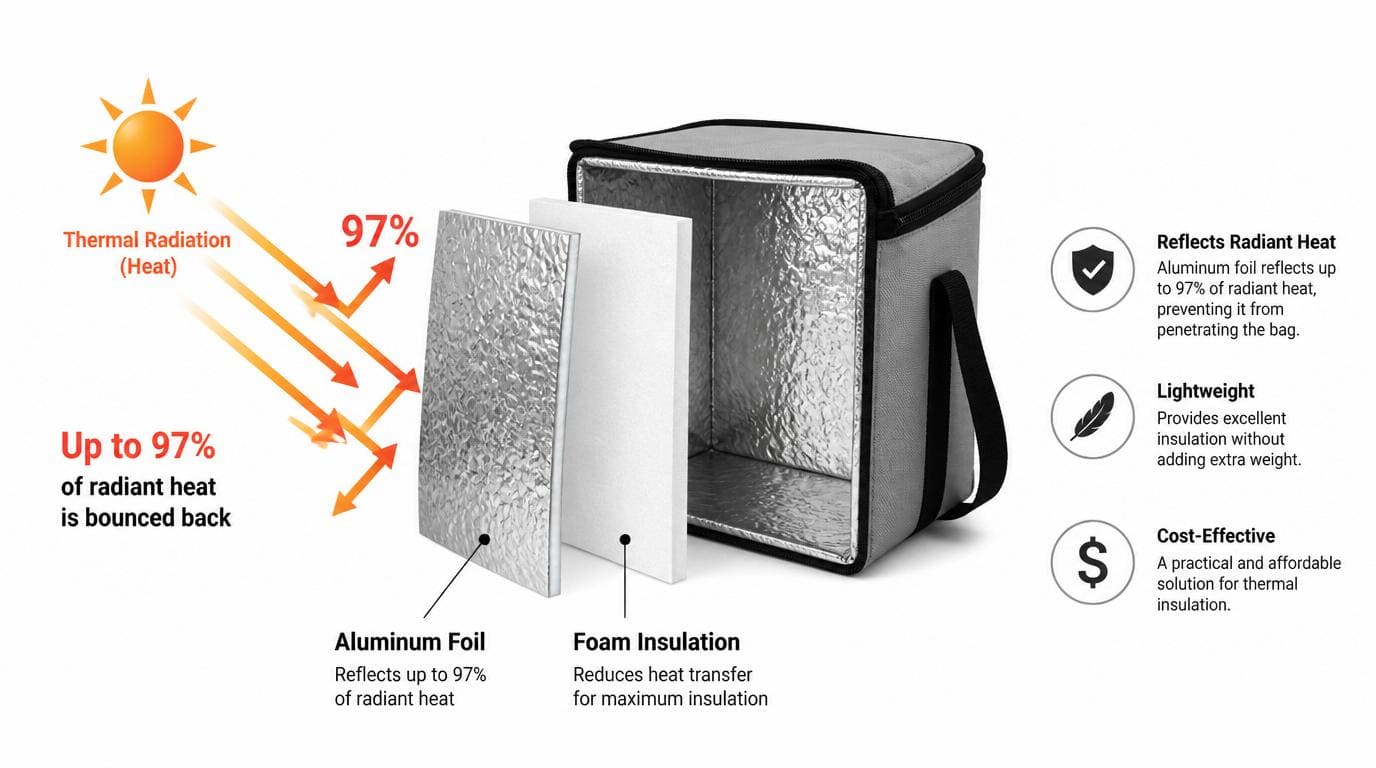
Aluminum foil works by reflecting a portion of infrared radiation away from the interior space.
However, there is a common misunderstanding:
“Does aluminum foil provide the insulation?”
The answer is no.
Aluminum foil is a reflective layer, not the main insulation barrier.
Its main function is to reduce radiant heat transfer. It works together with insulation materials that control conduction and convection.
A complete insulated bag structure usually combines:
- Reflective aluminum foil layer to reduce radiant heat.
- EPE pearl cotton or foam insulation to slow conductive heat transfer.
- Outer fabric to protect the structure.
- Inner lining to improve durability and cleaning performance.
Each layer performs a different role.
A bag with only a shiny silver interior may look like an insulated product, but without an effective insulation layer underneath, its thermal performance may be limited.
This is an important point for B2B buyers because many suppliers highlight the visual appearance of foil while ignoring the complete construction.
When comparing insulated bags, buyers should evaluate:
- Type of reflective material
- Bonding quality between layers
- Insulation material underneath the foil
- Overall structure design
A high-quality insulated bag is not created by adding one “special” material. It is created by combining different materials that solve different heat transfer problems.
The Complete Structure Inside an Insulated Bag
Many buyers initially focus on individual materials:
“Is it aluminum foil?”
“How thick is the foam?”
“What fabric is used outside?”
However, the actual performance of an insulated bag depends on how all layers work together.
An insulated bag is a thermal system.
Each layer has a specific function:
Outer Fabric
↓
Water-Resistant Layer
↓
Insulation Layer
↓
Reflective Aluminum Foil Layer
↓
Inner Lining
↓
Products
Although different manufacturers may adjust the structure based on application and cost requirements, the principle remains the same: every layer contributes to the final performance.
| Component | Main Function |
|---|---|
| Outer fabric | Protects the bag, improves durability, supports printing and branding |
| Insulation layer | Reduces heat transfer through conduction |
| Aluminum foil layer | Reflects radiant heat |
| Inner lining | Provides moisture resistance and easier cleaning |
| Closure system | Reduces air exchange and heat loss |
Outer Fabric Layer
The outer fabric is the first protective layer.
Its main purposes include:
- Protecting internal insulation materials.
- Improving durability during transportation.
- Supporting printing and branding.
- Providing water resistance.
- Improving product appearance.
Common outer fabrics include:
- Polyester
- Oxford fabric
- Non-woven fabric
For promotional cooler bags, appearance and printing quality may be important.
For delivery bags, durability and abrasion resistance may have higher priority.
However, the outer fabric alone does not determine thermal performance.
A premium-looking outer fabric cannot compensate for poor insulation inside.
Insulation Layer
The insulation layer is the main thermal barrier.
Its purpose is to slow heat movement through the bag wall.
Common insulation materials include:
- EPE pearl cotton
- Foam materials
- Multi-layer insulation structures
The performance of this layer depends on:
- Material quality
- Density
- Thickness consistency
- Manufacturing process
This is the part that most directly affects how quickly temperature changes occur inside the bag.
Reflective Layer
The aluminum foil layer helps reduce radiant heat transfer.
Its function is especially useful when the bag is exposed to:
- Direct sunlight
- Hot transportation environments
- Outdoor conditions
However, reflective materials are only one part of the system.
A reflective layer without sufficient insulation material underneath cannot provide complete thermal protection.
Inner Lining
The inner lining directly contacts the stored products or containers.
Its functions include:
- Improving cleaning ability.
- Providing moisture resistance.
- Protecting the insulation layer.
- Improving long-term usability.
For food-related applications, easy-clean inner materials are especially important because spills and condensation are common.
The key takeaway is that thermal performance comes from the entire structure.
Two bags may both have:
- Silver interior
- Similar size
- Similar outer fabric
But if their internal layers are different, their real performance can vary significantly.
This is why professional buyers should request detailed construction information instead of judging only by appearance.
Main Materials Used in Insulated Bags
Choosing the right material combination is one of the most important decisions when developing custom insulated bags.
Different applications require different priorities.
A grocery retailer may need lightweight reusable bags.
A food delivery company may need stronger insulation and frequent-opening durability.
A promotional brand may prioritize appearance and cost efficiency.
Understanding each material’s role helps buyers select the right structure.
EPE Pearl Cotton Insulation
EPE pearl cotton is one of the most commonly used insulation materials in reusable insulated bags.
It is popular because it provides a balance between:
- Thermal resistance
- Lightweight construction
- Flexibility
- Cost efficiency
Its closed-cell structure helps reduce heat transfer by limiting direct heat movement.
Advantages include:
- Easy processing during manufacturing.
- Good cushioning protection.
- Resistance to moisture absorption.
- Suitable for repeated use.
EPE pearl cotton is commonly found in:
- Grocery cooler bags
- Reusable shopping bags with insulation
- Lunch bags
- Beverage carriers
However, not all EPE materials provide the same performance.
Important factors include:
Density
Higher-quality insulation materials usually provide more stable performance because their internal structure is more consistent.
Low-density materials may appear similar visually but may not provide the same thermal resistance.
Thickness Consistency
During manufacturing, uneven insulation thickness can create weak areas where heat transfers more quickly.
Layer Bonding
Poor lamination between materials may create gaps that reduce insulation efficiency.
Therefore, buyers should evaluate the complete insulation specification rather than only asking for thickness.
Aluminum Foil Layer
Aluminum foil is widely recognized as a standard component in insulated bags.
Its main function is reflecting radiant heat.
Benefits include:
- Reflecting infrared radiation.
- Improving thermal stability in warm environments.
- Providing a clean inner appearance.
However, aluminum foil should not be considered a replacement for insulation materials.
A thin foil layer cannot stop heat transfer caused by conduction alone.
The best results come from combining:
- Reflective foil
- Insulation materials
- Proper closure design
This combination creates a more complete thermal barrier.
Outer Fabric Materials
The outer fabric affects durability, appearance, and user experience.
Common choices include:
| Material | Main Advantages | Common Applications |
|---|---|---|
| Polyester | Lightweight, strong, easy printing, cost-effective | Promotional cooler bags, retail bags |
| Oxford Fabric | Better abrasion resistance and durability | Food delivery bags, commercial cooler bags |
| Non-Woven Fabric | Affordable, lightweight, customizable | Reusable shopping bags, promotional programs |
Polyester Fabric
Polyester is widely used because it offers:
- Good strength
- Smooth printing surface
- Lightweight structure
- Easy maintenance
It is suitable for many retail and promotional applications.
Oxford Fabric
Oxford fabric is commonly selected when stronger durability is required.
Advantages include:
- Higher abrasion resistance
- Better structural support
- Suitable for repeated handling
It is often used in:
- Delivery bags
- Commercial cooler bags
- Outdoor applications
Non-Woven Fabric
Non-woven fabric is a cost-effective option often used for reusable shopping bags.
Advantages include:
- Lightweight
- Customizable printing
- Affordable production
It is suitable for applications where cost and branding are important.
However, the outer fabric mainly affects protection and appearance. The internal insulation structure remains the key factor controlling thermal performance.
Why Some Insulated Bags Perform Better Than Others
Many buyers expect a simple answer:
“Which insulated bag keeps temperature the longest?”
However, there is no universal answer.
Performance depends on how the bag is designed and how it will be used.
A bag designed for a short grocery trip does not need the same structure as a commercial food delivery bag.
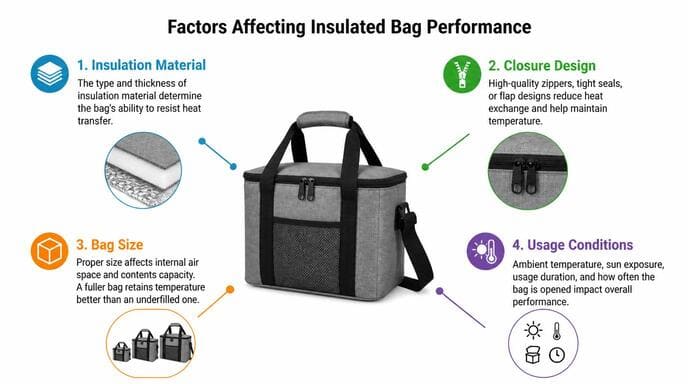
Several factors determine real-world insulation performance.
Insulation Material Quality
The insulation layer is the foundation of thermal performance.
Important factors include:
- Material type
- Density
- Thickness consistency
- Structural quality
Two bags using the same material name may perform differently because the actual material specifications can vary.
For example, “EPE insulation” describes a material category, but density and manufacturing quality influence the final result.
Layer Combination
A good insulated bag is not created by one excellent material.
The interaction between layers matters.
For example:
- Insulation slows conductive heat transfer.
- Aluminum foil reduces radiant heat.
- Inner lining protects the structure.
- Outer fabric improves durability.
Removing one important layer may weaken the overall system.
Closure Performance
The opening area is often where heat exchange happens fastest.
A bag with excellent insulation but poor sealing may lose performance quickly.
Factors include:
- Zipper quality
- Closure tightness
- Stitching accuracy
- Opening design
For frequent-use applications, closure design becomes especially important.
Bag Size
Size affects internal air volume.
A bag that is too large for its contents creates unnecessary empty space.
More empty space means:
- More internal air exchange.
- Faster temperature changes when opened.
Choosing the correct capacity improves efficiency.
How Usage Conditions Affect Insulated Bag Performance
Even a well-designed insulated bag cannot maintain temperature independently from its usage environment.
Insulation performance depends on several external factors:
| Factor | Impact on Performance |
|---|---|
| Product starting temperature | The bag maintains temperature but does not cool or heat products |
| Outside temperature | Larger temperature differences increase heat transfer |
| Opening frequency | More openings create more air exchange |
| Transportation time | Longer periods require stronger insulation structures |
| Product volume | Correct sizing reduces unnecessary empty space |
Product Starting Temperature
The first and most important factor is the temperature of the products before they enter the bag.
An insulated bag maintains an existing temperature. It does not reduce product temperature.
For example:
- Frozen products remain frozen longer because the bag slows heat entering from outside.
- Cold beverages stay chilled longer because heat transfer is reduced.
- Hot meals remain warm longer because heat loss is slowed.
However, if a product is already warm or partially melted before being placed inside the bag, the insulated bag cannot reverse that condition.
This is especially important for businesses operating food delivery or grocery services.
The correct expectation is:
“The bag reduces the speed of temperature change.”
Not:
“The bag makes the product cold again.”
External Temperature
The surrounding environment directly affects heat exchange.
A bag used indoors at room temperature faces different conditions from a bag exposed to:
- Summer heat
- Direct sunlight
- Hot vehicle interiors
- Outdoor transportation
Higher temperature differences create stronger heat movement.
An insulated bag does not stop heat completely. Instead, it reduces the speed at which heat enters or leaves the bag.
Opening Frequency
The number of times an insulated bag is opened can significantly affect performance.
Every opening allows air exchange between the inside and outside environment.
When the bag opens:
- Warm external air enters.
- Cooler internal air escapes.
- Temperature stability decreases.
This factor is especially important for:
- Food delivery bags
- Catering transport bags
- Commercial service bags
A delivery worker opening a bag many times per day creates different conditions compared with a consumer using a grocery cooler bag once.
Therefore, frequent-use applications usually require:
- Stronger closure systems.
- More durable materials.
- Better structural support.
Choosing the Right Insulated Bag Design for Different Applications
There is no single “best” insulated bag for every business.
The correct design depends on:
- Product type
- Transportation time
- Opening frequency
- Customer expectations
- Budget requirements
| Application | Recommended Features |
|---|---|
| Grocery insulated bags | Lightweight structure, reusable design, moderate insulation, easy carrying |
| Food delivery bags | Strong outer fabric, durable closure, better insulation, easy-clean lining |
| Promotional cooler bags | Good printing quality, attractive appearance, balanced cost and insulation |
| Retail programs | Consistent branding, reusable performance, customer-friendly design |
Grocery Insulated Bags
Grocery insulated bags are commonly used for:
- Frozen food pickup
- Fresh groceries
- Supermarket programs
- Reusable shopping systems
Typical requirements:
- Lightweight design
- Easy carrying
- Moderate insulation performance
- Reusable durability
- Attractive appearance
These bags usually prioritize convenience because users carry them for relatively short transportation periods.
Food Delivery Bags
Food delivery bags face more demanding conditions.
They experience:
- Frequent opening
- Longer transportation times
- Repeated daily use
- Different weather conditions
Important features include:
- Strong outer fabric
- Reliable closure
- Good structural support
- Easy-clean inner lining
The design focus is not only insulation but also operational durability.
Promotional Cooler Bags
Promotional insulated bags are often used for:
- Brand marketing
- Corporate events
- Retail promotions
Important considerations include:
- Printing quality
- Appearance
- Cost control
- Suitable insulation performance
The insulation structure can be adjusted according to the expected usage and marketing purpose.
How Manufacturers Ensure Insulated Bag Quality
For bulk buyers, thermal performance is not only about selecting the right material.
The manufacturing process determines whether the final products consistently perform according to expectations.
A sample bag may look excellent, but large-scale production requires strict quality control to ensure every unit has the same structure.
Professional insulated bag manufacturers usually control quality through several stages:
- Material inspection
- Production process control
- Finished product inspection
Material Inspection
Before production begins, manufacturers should check:
- Material thickness
- Density
- Lamination quality
- Fabric strength
- Waterproof performance
For insulation materials, visual inspection alone is not enough.
Materials with similar appearance may have different internal structures and performance.
Production Consistency
Bulk production requires control of:
- Cutting accuracy
- Layer alignment
- Sewing quality
- Closure installation
- Final assembly
Small differences multiplied across thousands of units can create significant quality variations.
For B2B buyers, the goal is not receiving one perfect sample.
The goal is receiving thousands of consistent products.
Quality Control System
A reliable supplier should have inspection procedures covering:
Before production:
- Raw material checking
- Fabric inspection
- Insulation material verification
During production:
- Cutting inspection
- Layer assembly checking
- Sewing inspection
- Closure testing
After production:
- Finished product inspection
- Appearance checking
- Packing verification
Selecting the Right Insulated Bag Manufacturer
Understanding how insulated bags work is important, but for businesses purchasing customized insulated bags in bulk, choosing the right manufacturing partner is equally important.
A supplier should not only provide a product sample. They should have the ability to produce stable quality at scale.
When evaluating an insulated bag manufacturer, buyers should focus on several practical factors.
Manufacturing Capability
A reliable manufacturer should have experience producing insulated bags for different applications.
Important factors include:
- Production capacity
- Equipment capability
- Material processing experience
- Quality control procedures
- Customization ability
A supplier with strong manufacturing capability can better control:
- Insulation consistency
- Sewing quality
- Layer bonding
- Printing accuracy
- Delivery stability
For bulk orders, production consistency is often more important than a single attractive sample.
Many buyers assume that purchasing directly from a factory will always guarantee the lowest price. In most cases, manufacturers can offer more competitive pricing than trading companies because they produce in-house, reducing outsourcing costs, middleman margins, and additional transportation expenses between different suppliers.
However, the lowest quotation does not always represent the best value. Some suppliers may reduce costs by using lower-grade materials, recycled fabrics with inconsistent performance, thinner non-woven fabrics, or by reducing quality inspection processes. These differences may not be obvious from a price sheet but can affect insulation performance, durability, and long-term product reliability.
Before choosing a manufacturer, buyers should conduct proper verification. Useful steps include reviewing the supplier’s product catalog, checking their previous cooperation experience with brands or retailers, requesting production photos or factory information, and evaluating their presence across different channels such as websites and social media platforms. A reliable manufacturer should be able to demonstrate not only competitive pricing but also stable production capability and a proven quality management process.
Material Knowledge
A professional supplier should understand how different materials affect performance.
They should be able to recommend suitable structures based on:
- Product type
- Required insulation time
- Usage environment
- Target price range
For example:
A lightweight grocery cooler bag and a commercial delivery bag should not use the same structure.
A supplier that only provides standard products may not be able to optimize the design for specific applications.
A knowledgeable manufacturer can help buyers choose the right balance between insulation performance, material durability, appearance, and cost instead of simply offering the cheapest available option.
Customization Ability
For brands and retailers, insulated bags are often not only functional products but also marketing tools.
Customization may include:
- Size adjustment
- Material selection
- Color matching
- Logo printing
- Handle design
- Closure options
- Packaging requirements
A capable manufacturer should help balance:
- Product performance
- Production cost
- Brand requirements
Conclusion: Insulated Bags Work by Controlling Heat Transfer
An insulated bag does not generate cold or heat.
Its purpose is to slow temperature change by reducing heat transfer through:
- Conduction
- Convection
- Radiation
A high-performance insulated bag combines multiple elements:
- Effective insulation materials
- Reflective layers
- Proper closure design
- Suitable outer fabrics
- Consistent manufacturing quality
For businesses sourcing insulated bags, understanding these principles helps make better purchasing decisions.
The best insulated bag is not always the thickest or the cheapest option.
It is the one designed with the right structure for the intended application and produced with reliable quality control.
Need Custom Insulated Bags for Your Business?
Whether you need insulated shopping bags, food delivery bags, promotional cooler bags, or custom thermal packaging, choosing the right structure is essential for product performance and customer satisfaction.
As an experienced insulated bag manufacturer, we help businesses develop customized solutions based on:
- Product requirements
- Usage scenarios
- Material preferences
- Branding needs
- Order volume
Contact us to discuss your custom insulated bag project and get professional recommendations for the right insulation structure.
Frequently Asked Questions About How Insulated Bags Work
Do insulated bags make things cold?
No.
Insulated bags do not create cold. They slow down heat transfer between the inside of the bag and the outside environment.
A frozen product stays frozen longer because the bag reduces the speed of heat entering.
How long can an insulated bag keep food cold?
The answer depends on:
- Insulation structure
- Material quality
- Outside temperature
- Opening frequency
- Product starting temperature
There is no universal time because different designs and conditions create different results.
Does aluminum foil make an insulated bag cold?
No.
Aluminum foil does not create cooling.
Its function is reflecting radiant heat.
The main insulation performance comes from the complete structure, including insulation materials, reflective layers, and closure design.
Is a thicker insulated bag always better?
Not necessarily.
Thickness can improve insulation, but performance also depends on:
- Material density
- Layer design
- Construction quality
- Sealing performance
A well-designed structure is more important than thickness alone.
What materials are used inside insulated bags?
Common internal materials include:
- EPE pearl cotton
- Foam insulation
- Aluminum foil
- Moisture-resistant lining materials
Different combinations are selected depending on application requirements.
How should businesses choose a custom insulated bag supplier?
Businesses should evaluate:
- Manufacturing capability
- Material knowledge
- Quality control system
- Customization experience
- Production consistency
The right supplier should provide not only bags but also technical support during product development.