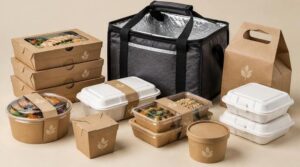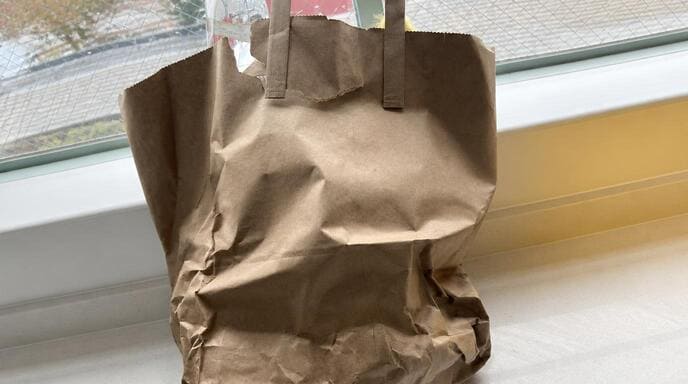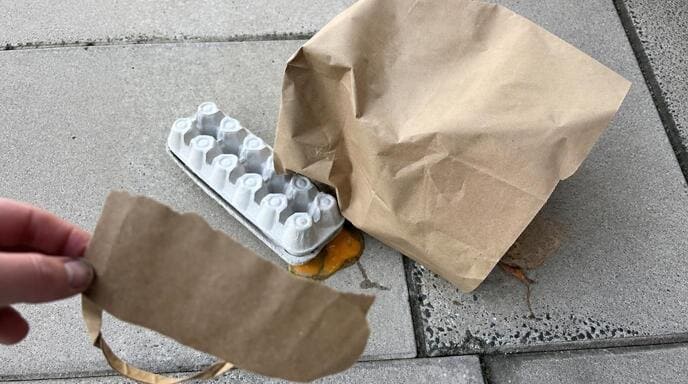
Food delivery packaging is the external container or transport packaging used to move prepared food from a restaurant, commercial kitchen, grocery business, caterer, or food producer to the customer. Common formats include insulated delivery bags, thermal totes, delivery backpacks, rigid insulated food carriers, reusable delivery crates, and cold-chain containers.
The right packaging depends on four practical factors: what is being delivered, how long it will be in transit, how much it weighs and occupies, and how it will be transported. Temperature requirements, weather, cleaning frequency, and repeated use also affect the specification.
For buyers, the objective is not simply to find a bag with thicker insulation or a stronger outer fabric. The finished packaging needs to provide the required combination of thermal retention, capacity, load strength, physical protection, portability, and durability.
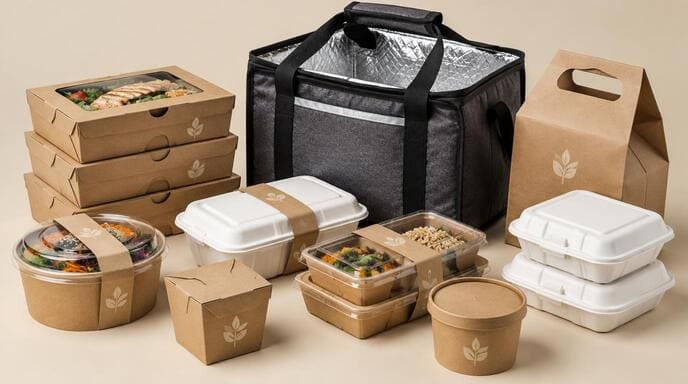
What Is Food Delivery Packaging?
Food delivery packaging is the outer transport container used during delivery, rather than the container that directly holds the food.
A typical delivery system may be:
Food → food container → takeaway bag or box → insulated delivery container → vehicle or delivery carrier
The outer delivery packaging protects the order from temperature changes, movement, compression, spills, and weather during transportation. DoorDash's current delivery guidance specifically recommends insulated bags for temperature control and separating hot and cold products during transport.
This is why food delivery packaging is broader than simply “food bags.” A small restaurant may use an insulated bag for several meal containers, while a catering company may require a rigid insulated carrier for larger and heavier loads.
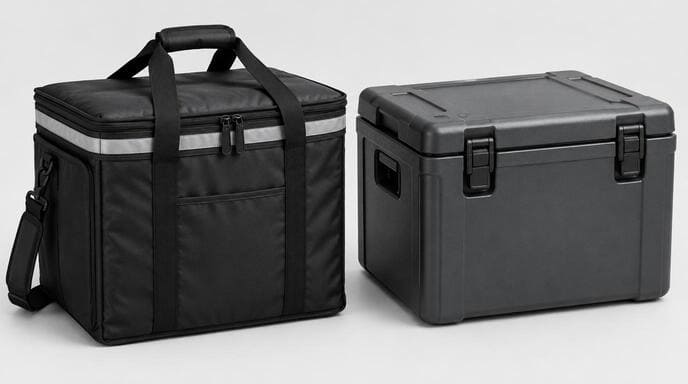
What Types of Food Delivery Packaging Are Commonly Used?
The main types can be distinguished by structure, capacity, thermal performance, and delivery method.
| Type | Bag/container features | Best suited for |
|---|---|---|
| Insulated delivery bag | Soft insulated bag with a zippered or hook-and-loop opening, handles, and thermal lining for carrying prepared meals. | 1–3 meal orders, short delivery routes, and routine restaurant delivery |
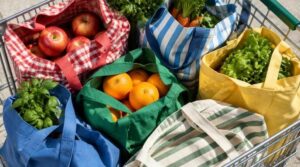
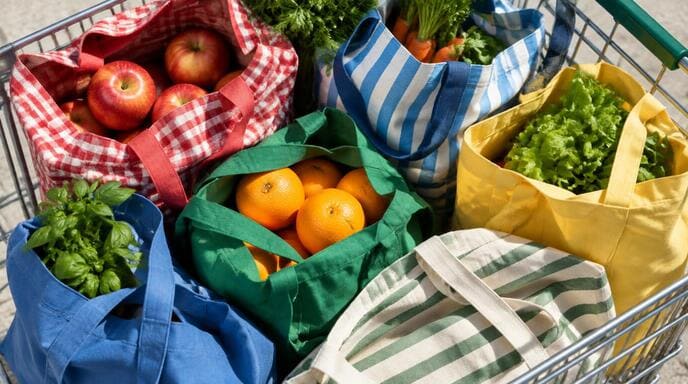
| Insulated tote bag | Open-top or wide-opening insulated bag with a large flexible interior for loading multiple food containers and grocery items. | Mixed grocery and meal orders, larger food loads, and multi-item deliveries |
| Insulated delivery backpack | Insulated backpack with shoulder straps and a large compartment that allows riders to carry food while keeping both hands free. | Hands-free rider delivery, especially bicycle, scooter, and motorcycle routes |
| Rigid insulated carrier | Hard-sided or semi-rigid insulated container that keeps its shape and helps prevent food containers from being crushed or shifted during transport. | Large meal quantities and catering orders requiring stronger physical protection |
| Reusable delivery crate with thermal liner | Rigid stackable crate with an optional insulated liner, providing a stable space for multiple food orders during repeated loading and vehicle transport. | Multiple orders or heavy grocery loads requiring repeated handling and stacking |
| Cold-chain insulated container | Thick-walled insulated container designed to hold cold sources such as gel packs or ice packs and maintain a controlled temperature during transport. | Frozen and chilled products requiring a controlled temperature range during longer transport |
1. Insulated Delivery Bags
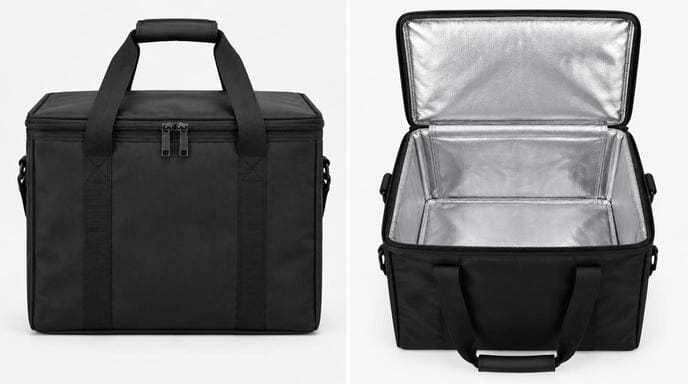
Insulated delivery bags are one of the most common formats for restaurant delivery. A typical bag combines an outer fabric, insulation layer, inner lining, and closure system.
Outer materials can include PP non-woven, RPET non-woven, polyester, Oxford fabric, nylon, or coated fabric. Flexible insulation commonly uses EPE or PE foam, while some higher-performance designs use PU-based insulation.
The size should follow the actual order rather than a generic “large” or “extra-large” classification. Commercial delivery bags can range from roughly 10–15 L for small orders to 50–80 L or more for large multi-order or catering applications.
A bag measuring 40 × 30 × 35 cm internally has a theoretical volume of:
40 × 30 × 35 ÷ 1,000 = 42 L
The usable capacity will be lower if insulation, dividers, reinforcement, or internal structure occupy part of that space.
For restaurant delivery, flexible insulated bags are useful when the priorities are thermal protection, low weight, easy carrying, and efficient storage when empty.
2. Insulated Totes
Insulated totes generally have a wider opening and more flexible internal space than conventional delivery bags. They are commonly suited to grocery delivery, meal delivery, prepared food, and mixed-size orders.
The main advantage is loading flexibility. Different food containers, drinks, and packaged products can be arranged in the same compartment without requiring a rigid internal geometry.
A tote is less suitable when the order needs strong protection against crushing or stacking. In those situations, a rigid carrier may provide better physical protection.
3. Insulated Delivery Backpacks
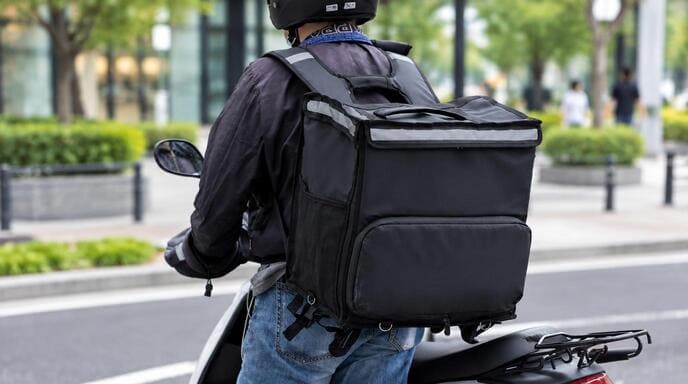
Insulated backpacks are designed for delivery by bicycle, motorcycle, or other situations where the driver needs both hands available.
Because the load is carried on the driver's back, the construction needs more than insulation. Shoulder straps, back panels, seams, base reinforcement, and internal stability all become important.
Backpacks are particularly suitable for smaller and medium-sized orders. Increasing the volume indefinitely is not necessarily practical because a very large backpack becomes more difficult to carry and control.
4. Rigid Insulated Boxes and Food Carriers
Rigid insulated carriers are designed for applications where thermal protection and physical protection are both important.
Common structures include EPP, EPS, rigid polypropylene, corrugated polypropylene, and rigid plastic shells with insulation.
They are suitable for catering, institutional foodservice, bulk meal delivery, and vehicle-based transport. Their rigid walls help protect containers from crushing and make stacking easier.
The trade-off is storage. A rigid carrier that measures 60 × 40 × 40 cm occupies approximately 96 L of external volume even when empty, whereas a collapsible fabric bag can reduce its storage footprint substantially.
5. Reusable Delivery Crates
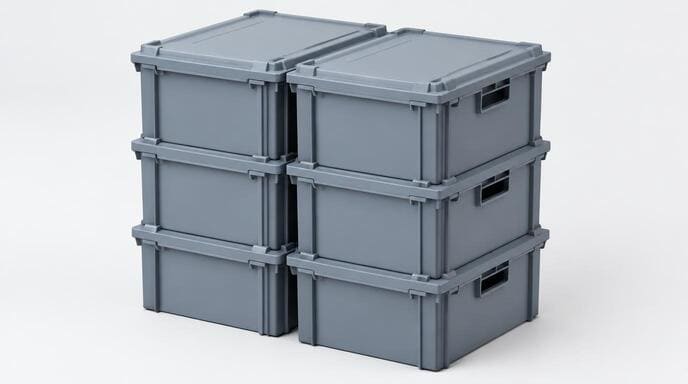
Reusable crates are mainly used for organization, stacking, and repeated transport. They are common in vehicle-based delivery systems where multiple orders need to remain separated and stable.
Plastic or polypropylene crates provide structural protection but do not automatically provide meaningful thermal insulation. When temperature control is required, they can be combined with insulated liners or placed inside an insulated carrier.
6. Cold-Chain Containers
Cold-chain packaging is used for chilled and frozen products where temperature control is more demanding than ordinary restaurant delivery.
A typical system combines:
Insulated container + cold source + controlled loading + defined delivery time
Cold sources can include ice packs or frozen gel packs. USDA guidance recommends using ice or frozen gel packs when transporting cold food.
Insulation alone does not create cold. It slows the rate at which heat enters the container. Therefore, a bag containing food at 4°C will gradually warm in a 30°C environment unless the system includes sufficient thermal protection and, where required, a cold source.
How Do You Choose the Right Food Delivery Packaging?
The most practical way to select packaging is to work through the delivery conditions in order.
1. Start With the Food
The first question is whether the order is hot, chilled, frozen, or mixed.
Hot meals primarily require protection against heat loss. Chilled and frozen products require protection against heat gain and may require ice packs or another cold source. Mixed orders may need separate compartments or separate bags.
Hot food and cold drinks should not simply be packed together in a small compartment. DoorDash's delivery guidance also recommends separating hot and cold items during transportation.
Food structure matters as well. Soup, sauces, fried food, beverages, and delicate products place different demands on the delivery system. Containers should remain upright and stable, while foods that release steam may require appropriate ventilation rather than a completely sealed environment.
2. Match the Packaging to Delivery Time
Delivery duration directly affects the required thermal performance.
| Typical delivery time | Packaging consideration |
|---|---|
| Under 30 min | Basic insulated transport may be sufficient for many hot-food routes |
| 30–60 min | Insulation, closure, and loading become more important |
| 60–120 min | Finished-bag thermal testing becomes increasingly important |
| Over 120 min | Temperature-sensitive products may require a more controlled thermal system |
These are application ranges, not food-safety standards. Actual requirements depend on the food, local regulations, starting temperature, ambient conditions, and handling process.
For temperature-controlled foods, the FDA Food Code 2022 specifies 57°C (135°F) or above for hot holding and 5°C (41°F) or below for cold holding. The FDA Food Code is a model code adopted by jurisdictions rather than a universal law.
USDA consumer guidance uses 4.4°C–60°C (40°F–140°F) as the food-safety “Danger Zone” and advises that perishable food should not remain there for more than 2 hours, or 1 hour when the surrounding temperature exceeds 32.2°C (90°F).
These figures should not be interpreted as a guarantee that a particular delivery bag maintains a temperature for a particular number of hours. A thermal bag's performance has to be tested under defined conditions.
3. Calculate the Required Capacity
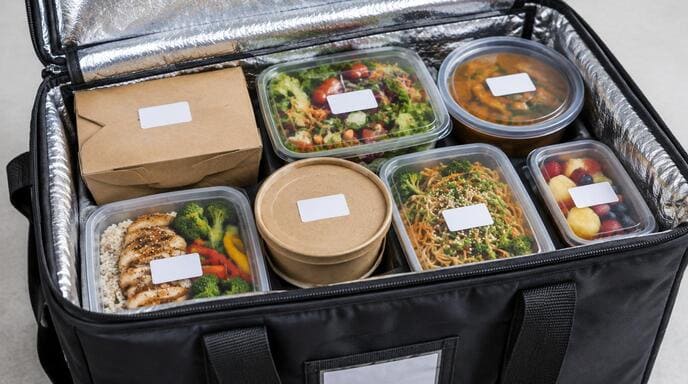
Capacity should be based on the actual food containers and loading pattern.
Suppose four meal containers each measure 30 × 20 × 6 cm.
One container occupies:
30 × 20 × 6 = 3,600 cm³ = 3.6 L
Four containers require approximately 14.4 L of theoretical volume before adding drinks, sauces, dividers, clearance, and space between containers.
A nominal 15 L bag would therefore be too tight for this order even though the basic volume calculation appears to match.
This is why buyers should specify usable internal dimensions, not only nominal volume.
4. Match Load Capacity to the Actual Order
Thermal capacity and load capacity are different specifications.
A bag may have enough internal volume for a 15 kg order but still not be structurally designed to carry 15 kg repeatedly.
The load-bearing points include the bottom panel, handle attachment, seams, fabric, reinforcement, zipper, and internal structure.
For a commercial application requiring a maximum load of 10 kg, the finished bag should be tested at 10 kg. A catering bag specified for 15 kg should be tested at that load rather than assuming that a thicker fabric automatically provides sufficient capacity.
5. Consider How the Bag Will Be Transported
The same food order can require different packaging depending on the delivery method.
| Delivery method | Useful packaging features |
|---|---|
| Walking | Handles, shoulder strap, moderate weight |
| Bicycle | Backpack construction, stable base, compact shape |
| Motorcycle | Reinforced base, secure closure, stable internal structure |
| Car/van | Larger capacity, stackability, rigid structure if needed |
| Catering vehicle | High load capacity, rigid carriers, standardized dimensions |
For high-volume vehicle delivery, standardized sizes can also improve stacking and reduce unused space.
What Materials Are Used for Food Delivery Packaging?
Different materials perform different functions, so the complete construction matters more than the outer fabric alone.
PP non-woven is commonly selected for lightweight, printable, cost-sensitive delivery bags. RPET non-woven can be used when recycled polyester content is required. Polyester, Oxford fabric, and nylon provide woven outer structures with different abrasion and appearance characteristics. PVC-coated fabric can improve surface moisture resistance and make cleaning easier.
For insulation, flexible bags commonly use EPE or PE foam, while some designs use PU-based insulation. Rigid carriers may use EPP or EPS.
A reflective aluminum film can be added to the lining. It can help reflect radiant heat, but foil is not a replacement for insulation thickness.
This is why specifications such as “600D Oxford + aluminum foil” are incomplete if the buyer needs a thermal-performance target. The insulation material, thickness, closure, dimensions, and test conditions also need to be defined.
How Much Insulation Does a Delivery Bag Need?
There is no single thickness that works for every application.
Flexible insulated bags may use approximately 3–15 mm or more of insulation depending on the construction and performance target. A thin promotional cooler bag and a commercial delivery bag designed for longer routes can therefore have very different insulation structures.
Thickness alone does not determine thermal performance because different materials have different thermal conductivity.
For procurement, the more useful specification is:
Insulation material + thickness + finished-bag thermal test
rather than simply requesting “thick insulation.”
The closure is also important. A thick insulated wall cannot completely compensate for a large thermal gap around an inadequately sealed zipper or opening.
How Long Can an Insulated Food Delivery Bag Keep Food Hot or Cold?
There is no universal “4-hour” or “6-hour” performance figure for insulated delivery bags.
Thermal retention changes with:
- Starting food temperature
- Ambient temperature
- Food mass
- Internal air volume
- Insulation material and thickness
- Closure
- Number of openings
- Container arrangement
- Cold or heat source
A fully loaded bag can perform differently from the same bag containing one small meal because the thermal mass is different.
For a commercial order, the meaningful test is therefore based on the real delivery cycle. If the target delivery time is 90 minutes, measure the finished bag at 0, 30, 60, and 90 minutes under a defined ambient temperature and loading condition.
That result is more useful than a generic statement such as “keeps food hot for 6 hours.”
Does Waterproof Fabric Make a Delivery Bag Waterproof?
No.
A coated Oxford, polyester, or non-woven exterior can improve resistance to rain and splashes, but the finished bag also contains seams, stitching holes, zippers, handles, and bottom joints.
If the bag is used outdoors in wet conditions, the complete product should be tested.
For food delivery, surface moisture resistance can also make cleaning easier, but it should not be confused with full waterproof construction.
What Should You Test Before Ordering in Bulk?
A production sample should be tested under conditions close to actual delivery.
| Test | What to measure |
|---|---|
| Thermal test | Temperature at defined time intervals |
| Load test | Performance at intended maximum load |
| Handle test | Handle and attachment strength |
| Bottom test | Deformation and seam performance |
| Closure test | Zipper, flap, buckle, or hook-and-loop durability |
| Moisture test | Resistance to rain and spills |
| Cleaning test | Ease of wiping and repeated-use condition |
For thermal testing, record the starting temperature, ambient temperature, food load, container type, delivery duration, and number of openings.
For a 90-minute delivery application, a useful test sequence is 0 → 30 → 60 → 90 minutes.
For a 15 kg load requirement, test the finished bag at 15 kg, including the handles and bottom rather than testing only the fabric.
What Should Be Included in a Food Delivery Packaging Specification?
For bulk purchasing, the specification should be specific enough that two suppliers can quote essentially the same product.
| Specification | Example |
|---|---|
| Application | Restaurant hot-food delivery |
| External size | 45 × 35 × 40 cm |
| Internal size | Specified separately |
| Usable capacity | 40 L |
| Maximum load | 10 kg |
| Outer material | PP non-woven / Oxford |
| Insulation | EPE, 10 mm |
| Lining | Aluminum-coated film |
| Closure | Zipper |
| Carrying method | Hand + shoulder strap |
| Delivery time | 60–90 min |
| Temperature target | Defined by application |
| Testing | Thermal + load + moisture |
This prevents a common purchasing problem: two bags may have identical external dimensions but very different internal capacity, insulation thickness, reinforcement, and usable performance.
How Do You Choose Between Food Delivery Bags and Rigid Carriers?
The decision is mainly a trade-off between portability and structural protection.
Choose a flexible insulated bag when the operation prioritizes low weight, easy carrying, foldable storage, and frequent loading and unloading.
Choose a rigid insulated carrier when the operation prioritizes stacking, physical protection, larger loads, or stable internal positioning.
For bicycle and motorcycle delivery, backpacks can improve mobility. For grocery and mixed orders, insulated totes provide flexible loading. For chilled and frozen products, the packaging should be evaluated as a complete temperature-control system rather than as an insulated bag alone.
Conclusion
Food delivery packaging includes insulated bags, totes, backpacks, rigid carriers, reusable crates, and cold-chain containers. The appropriate type depends on food temperature, delivery time, order size, load weight, transport method, and environmental conditions.
For most purchasing decisions, start with the actual delivery process: determine the required capacity and load, define the delivery time and temperature target, select the packaging structure, and then test the finished sample.
For custom food delivery packaging, suppliers can develop the bag around specific requirements such as 40 L capacity, 10–15 kg load, 60–90 minute delivery, specified insulation thickness, custom printing, reinforced handles, or water-resistant construction. Testing the production sample before bulk manufacturing provides a practical way to confirm that the packaging matches the intended delivery operation.
FAQ
What is the most common type of food delivery packaging?
Insulated delivery bags are widely used for restaurant and last-mile food delivery because they combine thermal protection, portability, and relatively low weight. Insulated totes and backpacks are variations suited to different loading and transport methods. DoorDash also recommends insulated bags for maintaining food temperature during delivery.
What is the difference between a food delivery bag and an insulated food delivery bag?
A food delivery bag describes the transport format generally, while an insulated delivery bag specifically contains a thermal insulation layer designed to slow temperature change. For hot, chilled, or frozen products, insulation becomes an important part of the specification.
How big should a food delivery bag be?
The size should be based on the actual food containers and order volume. For example, four containers measuring 30 × 20 × 6 cm require about 14.4 L of theoretical volume before allowing space for drinks, sauces, dividers, and clearance. Usable internal dimensions are therefore more useful than a nominal bag size.
How long can a food delivery bag keep food hot?
There is no universal time. Performance depends on the insulation, food load, starting temperature, ambient temperature, closure, and opening frequency. The appropriate method is to test the finished bag over the actual delivery period rather than relying on a generic “4-hour” or “6-hour” claim.
Can an insulated bag keep food frozen?
An insulated bag slows heat gain but does not generate cold. Frozen products may require ice packs or another suitable cold source, particularly when delivery takes longer or ambient temperatures are high. USDA guidance recommends using ice or frozen gel packs when transporting cold food.
What material is best for a food delivery bag?
There is no single material that suits every application. PP non-woven, RPET non-woven, polyester, Oxford, nylon, and coated fabrics can all be used for different outer-bag requirements, while EPE, PE foam, PU, EPP, and EPS can serve different insulation or structural roles. The finished construction matters more than the outer material alone.
Should food delivery packaging be waterproof?
It depends on the delivery environment. For outdoor delivery, a water-resistant outer fabric and protected seams can help with rain and spills. Full waterproof performance requires the complete finished construction, including seams and closures, to be tested.
What should I ask a supplier before ordering food delivery bags?
Specify the application, external and internal dimensions, usable capacity, maximum load, outer material, insulation material and thickness, lining, closure, delivery time, temperature target, printing, and required tests. These details allow suppliers to quote and produce against the same requirements.