Choosing the right lunch bag size is not just about finding a bag that fits a lunch box. A bag can have enough overall volume but still be difficult to use if the internal space, container arrangement, or opening does not match what needs to be carried.
The key is to size the bag from the inside out: start with the lunch box, bottle, ice pack, and other items, determine how they will be arranged, then account for clearance, insulation, and the opening before setting the final external dimensions.
A practical sizing process follows six steps:
- Measure the main lunch container.
- Add other essential items, such as a bottle, ice pack, and utensils.
- Plan how the items will be arranged inside the bag.
- Allow practical clearance for loading and removal.
- Check the opening size, especially for rigid containers.
- Set the external dimensions after confirming the required internal space and insulation.
This approach is more reliable than choosing a lunch bag by size label or liter capacity alone.
Why Lunch Bag Size Matters
Lunch bag size directly affects capacity and everyday usability. A compact bag may be convenient for a child or a light lunch, while a larger insulated bag may be more appropriate for meal preparation, outdoor work, or carrying several food containers.
However, lunch bag size involves more than volume. Two bags with similar external dimensions can have noticeably different usable space because of differences in insulation thickness, lining, seams, gusset construction, and closure design.
There are three measurements worth distinguishing:
- External dimensions: The overall outside dimensions of the finished bag.
- Internal dimensions: The approximate space available inside the insulated compartment.
- Usable capacity: The space that can realistically be occupied by food containers and accessories.
For example, a lunch bag may have an external size of 25 × 15 × 20 cm, but its internal compartment will be smaller once insulation and construction allowances are considered.
This is particularly important when the bag is designed around rigid lunch boxes. A theoretical volume may look sufficient on paper, but the actual opening or compartment shape may prevent a container from fitting.
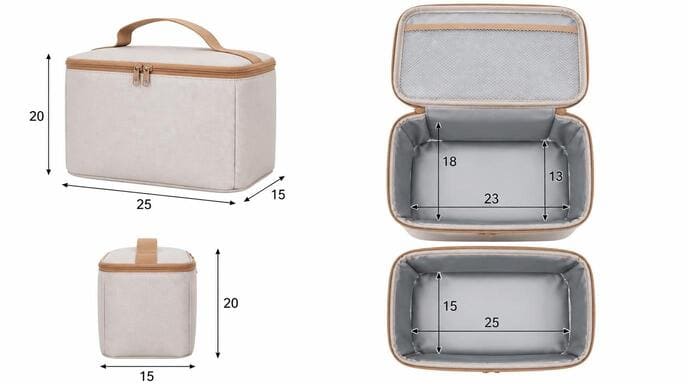
Key Point: Size affects more than storage volume. When comparing lunch bags, consider the container dimensions, opening size, internal compartment, insulation, and carrying requirements together.
Common Lunch Bag Sizes and Their Uses
There is no universal standard for small, medium, or large lunch bags. Manufacturers may use different size labels, so actual dimensions are more reliable than labels.
The following ranges are practical references for individual lunch bags. They are approximate and may vary by shape, insulation, and construction.
| Size | Approx. external dimensions | Typical use |
|---|---|---|
| Small | 15–22 × 10–15 × 15–20 cm | Snacks, small meals, children's lunches |
| Medium | 20–28 × 12–18 × 18–23 cm | Typical individual lunches |
| Large | 25–35 × 15–22 × 20–28 cm | Larger meals, drinks, meal prep |
| Extra-large | 30 cm+ on one side | Multiple meals, catering, commercial use |
Small bags prioritize portability and are suitable for light meals or snacks. Medium bags generally offer a good balance between capacity and portability for everyday use. Large and extra-large bags are better suited to multiple containers, larger meals, or commercial applications.
These ranges should be treated as general references, not fixed industry standards. The actual size required depends on the contents, packing arrangement, opening, insulation, and internal space.
How to Measure a Lunch Bag Correctly
Before selecting a size, determine how the bag's dimensions are being measured.
For a rectangular lunch bag, the basic dimensions are usually expressed as:
Length × Width × Height
However, manufacturers may describe these dimensions differently depending on the bag's orientation. For this reason, the physical measurement points should be clearly defined when ordering a custom product.
A practical approach is to identify:
- Length: The horizontal dimension across the main compartment.
- Width or depth: The front-to-back dimension or gusset.
- Height: The vertical distance from the bottom to the top of the compartment.
The gusset is especially important for soft lunch bags. A wider gusset creates more three-dimensional storage space than a flat pouch with the same front-panel dimensions.
External measurements should also be separated from internal measurements. If a bag uses 5 mm insulation on each side, the internal compartment can lose approximately 10 mm across a given dimension before accounting for lining, seams, or construction details.
The opening should also be checked. A lunch bag can have sufficient internal volume but still be inconvenient if its zipper opening is too narrow for a rigid lunch box.
Key Point: Measure the bag as length × width × height, but always clarify the measurement points. For practical use, check the internal compartment and opening, not just the outside dimensions.
Match Lunch Bag Size to the Food Containers
The most reliable way to select a lunch bag is to start with the objects that must fit inside it.
Instead of asking, "How many liters do I need?", first measure the largest lunch container and then consider the complete packing arrangement.
For example, suppose a user carries:
- Lunch box: 22 × 15 × 7 cm
- Water bottle: approximately 7 cm in diameter × 22 cm high
- Ice pack: 15 × 10 × 2 cm
- Small utensils
The bag should not be designed around the lunch box dimensions alone. Space is also needed for the bottle, ice pack, and practical clearance.
Container orientation matters as well. A bottle standing vertically may require more height, while placing it horizontally may require additional width or length.
A useful rule is to allow some clearance rather than designing the compartment to exactly match the container. Flexible bags can tolerate some variation, but rigid containers need enough space to be inserted and removed without excessive force.
The zipper position also matters. If the top opening is significantly smaller than the body of the bag, the nominal internal dimensions may not represent the actual ease of packing.
Example of a Practical Packing Arrangement
Suppose the lunch box is placed flat at the bottom of the bag, the bottle stands vertically beside it, and the ice pack is positioned along the side or top.
In this arrangement, the bag must accommodate the combined footprint and height of the items, not simply their individual volumes.
The required internal dimensions should therefore be determined by the largest overall dimensions of the packing arrangement, with additional clearance for loading and removal.
This is why adding the volume of each item does not always provide a reliable way to determine the required lunch bag size.
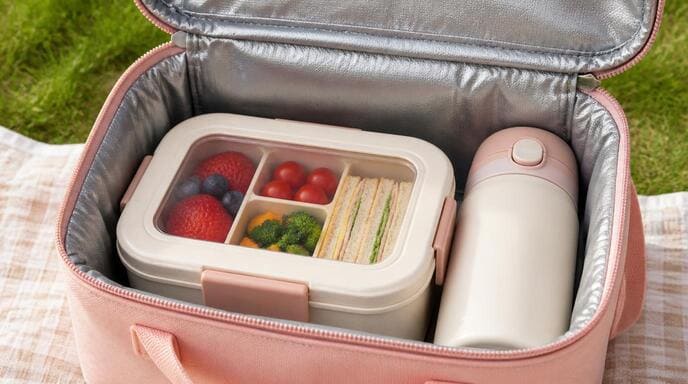
Key Point: Start with the largest container and the complete packing arrangement. Add practical clearance for insertion, removal, ice packs, bottles, and utensils instead of matching the bag dimensions exactly to the food container.
Lunch Bag Capacity: Liters vs. Dimensions
Lunch bag capacity is commonly described in liters, but liters and physical dimensions answer slightly different questions.
For a simple rectangular compartment, theoretical volume can be estimated as:
Length × Width × Height ÷ 1,000 = Approximate liters
For example:
25 × 15 × 20 cm ÷ 1,000 = 7.5 liters
This does not mean the bag will provide 7.5 liters of practical packing capacity.
A flexible insulated lunch bag may have rounded corners, tapered sides, thick insulation, seams, and internal construction that reduce usable space. Food containers also do not fill every part of the compartment efficiently.
When Liters Are Useful
Liter capacity is useful when comparing bags with different shapes or when describing the approximate overall storage class of a product.
When Dimensions Are More Useful
Dimensions are more useful when a specific lunch box, bottle, or meal-prep container must fit.
For custom lunch bags, it is therefore better to specify both:
Target internal dimensions + approximate capacity
rather than relying on a capacity number alone.
Key Point: Liters are useful for comparing general capacity, while internal dimensions are more important when a specific container must fit. The calculated volume should be treated as theoretical rather than guaranteed usable capacity.
Choosing the Right Size for Different Users
The right lunch bag size depends on the user's routine, the amount of food carried, and how the bag will be used.
| User | Recommended size | Main consideration |
|---|---|---|
| Office workers & students | Small–Medium | Balance lunch capacity with portability and storage space |
| Children | Small | Keep the bag compact, lightweight, and easy to carry |
| Outdoor workers | Medium–Large | Allow extra space for food, drinks, and larger ice packs |
| Travelers | Small–Medium | Prioritize compact or foldable designs for easy storage |
| Meal-prep users | Medium–Large | Match the compartment to the number and arrangement of containers |
| Delivery & commercial use | Large–Extra-large | Size according to container dimensions, order volume, and handling needs |
For personal use, capacity and portability should be balanced. For meal prep and commercial applications, the size and arrangement of the contents are usually more important than the size label alone.
How Insulation Affects Lunch Bag Size
Insulation creates an important difference between external and internal dimensions.
Consider two lunch bags with identical external dimensions. If one uses thicker insulation, its internal compartment will normally be smaller.
For example, increasing insulation thickness by several millimeters on multiple sides can reduce the internal length, width, and height simultaneously. The total reduction in theoretical volume can therefore be greater than the change in any single dimension suggests.
This creates a design trade-off:
More insulation → potentially better thermal resistance but less internal space
Larger external dimensions → more internal space but greater material use and bulk
The actual thermal performance of a lunch bag also depends on more than insulation thickness. Material type, construction, zipper design, seams, lining, and how the bag is used all influence heat transfer.
Therefore, simply making a lunch bag larger is not a substitute for appropriate insulation design.
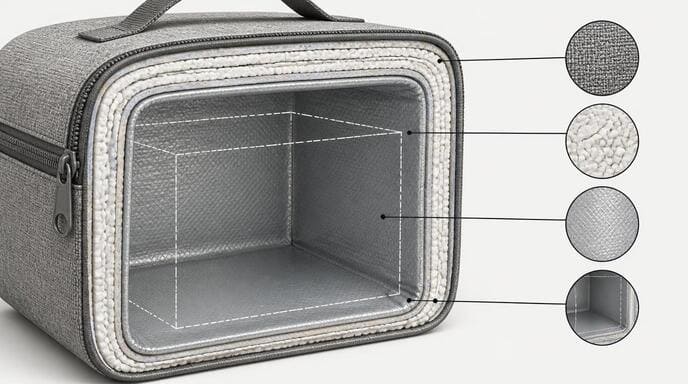
Key Point: Insulation thickness directly affects usable space. When designing or buying a lunch bag, balance internal capacity, external size, insulation construction, and portability rather than maximizing only one factor.
Common Lunch Bag Sizing Mistakes
Choosing Only by External Dimensions
A listed size such as 25 × 15 × 20 cm does not tell the user exactly how much food can fit inside. Insulation and construction reduce the internal space.
Ignoring the Bottle
A lunch box may fit perfectly while the bottle does not. If the drink is part of the daily load, its dimensions should be included before choosing the bag.
Making the Compartment Too Tight
A bag that technically fits a container may still be difficult to use. Rigid containers need reasonable clearance for loading and removal.
Using Capacity Alone
A 7-liter bag does not guarantee that a particular 7-liter combination of containers will fit. Shape and arrangement matter.
Making the Bag Excessively Large
Extra space can increase the bag's bulk, material consumption, packing volume, and shipping requirements without providing meaningful benefits to the user.
Confusing Measurement Methods
When sourcing custom bags, suppliers may refer to finished dimensions, external dimensions, internal dimensions, or flat dimensions. These terms should be confirmed before production.
Key Point: The most common sizing problems come from focusing on one number instead of the entire packing system. Check containers, opening size, internal space, insulation, and measurement definitions together.
How to Choose the Right Size for a Custom Lunch Bag
For custom lunch bags, the sizing process should begin with the intended contents rather than an arbitrary standard size.
1. Define the Contents
List the lunch box, bottle, ice pack, utensils, and any other items that need to be carried. Measure the largest and most restrictive items.
2. Determine the Internal Dimensions
Arrange the contents in the way they will normally be packed. Then determine the minimum internal length, width, and height required.
3. Add Practical Clearance
Allow enough room for easy loading and removal. Do not design the compartment as an exact mold around rigid containers unless there is a specific reason to do so.
4. Specify Insulation
Confirm the insulation material and thickness before finalizing external dimensions. The same internal target may require different external dimensions depending on the construction.
5. Confirm the Opening
Check whether the zipper or top opening is large enough for the largest container. This is particularly important for tall or rigid lunch boxes.
6. Make a Sample
A physical sample is one of the most reliable ways to confirm whether the proposed dimensions work in practice. Test the actual lunch box, bottle, ice pack, and accessories rather than relying only on calculated volume.
7. Consider Production and Shipping
For large-volume orders, dimensions affect more than material consumption. Finished bag size can influence folding method, carton quantity, carton volume, storage space, and shipping efficiency.
A small dimensional adjustment can therefore have a meaningful effect when thousands of bags are produced.
For custom production, the overall process can be summarized as:
Contents → Internal dimensions → Clearance → Insulation → Opening → External dimensions → Sample testing → Production and shipping review
This sequence helps separate the functional requirements of the bag from its final external size.
FAQ
What size lunch bag do I need for a lunch box?
Measure the lunch box first, then add space for a drink, ice pack, utensils, and practical clearance. The bag's internal dimensions and opening size are more important than its stated liter capacity when a specific lunch box needs to fit.
What is a good size for a single-person lunch bag?
For a typical individual lunch, a medium bag in the approximate range of 20–28 × 12–18 × 18–23 cm can be a useful starting point. The exact size should be based on the lunch container, drink, ice pack, and other contents.
How big should a lunch bag be?
The lunch bag should be large enough to hold all required containers with enough clearance for convenient packing and removal. There is no single ideal size because the required dimensions depend on the contents and their arrangement.
How many liters should a lunch bag be?
Many individual lunch bags fall roughly within the 5–10 liter range, although this is not a strict standard. A smaller bag may be enough for a light meal, while meal-prep or multi-container use may require more capacity.
Should a lunch bag be bigger than the lunch container?
Yes. The bag should provide enough additional space for practical loading and for other items such as an ice pack or drink. However, excessive clearance makes the bag unnecessarily bulky.
How do I calculate the usable capacity of a lunch bag?
First calculate the theoretical internal volume using length × width × height. Then treat the result as an approximation because insulation, seams, rounded corners, bag shape, and packing arrangement reduce the practical capacity.
Does thicker insulation require a larger lunch bag?
If the target internal capacity remains unchanged, thicker insulation generally requires larger external dimensions. If the external dimensions remain fixed, thicker insulation normally reduces internal space.
What lunch bag size is best for meal prep?
Meal-prep users should select the size according to the number, dimensions, and arrangement of their containers. A wider or taller compartment may be more useful than simply choosing a bag with a higher stated liter capacity.
What should I provide when ordering a custom lunch bag?
Provide the dimensions of the main food containers, bottles, ice packs, and other items that need to fit inside. It is also useful to specify the desired internal dimensions, insulation type and thickness, opening style, quantity, and any folding or shipping requirements.
Conclusion
The right lunch bag size is ultimately determined by what needs to fit inside the bag and how the bag needs to be carried, rather than by a standard size label or liter rating.
For everyday use, start by measuring the lunch container, drink, ice pack, and other essential items. Then consider how they will be arranged inside the compartment and allow enough clearance for convenient packing. Check the internal dimensions, opening size, gusset, and insulation thickness before relying on the bag's external dimensions.
For custom lunch bag production, the most reliable approach is to define the required contents first, establish the target internal dimensions, account for insulation and construction, and verify the design with a physical sample. Production and shipping requirements should then be reviewed before finalizing the finished dimensions.
This approach helps ensure that the finished bag is large enough to be practical without becoming unnecessarily bulky or costly.