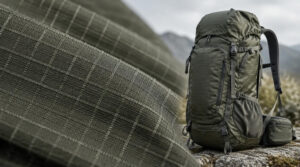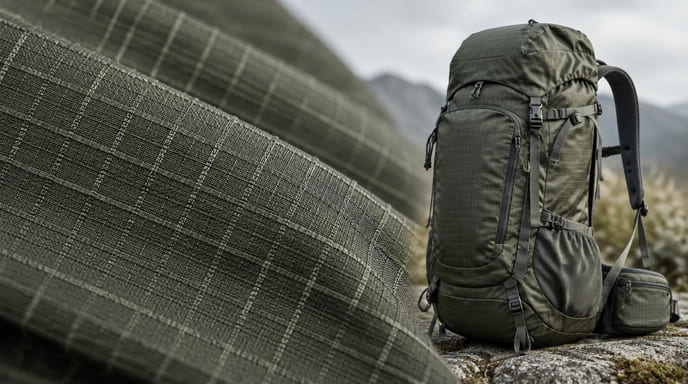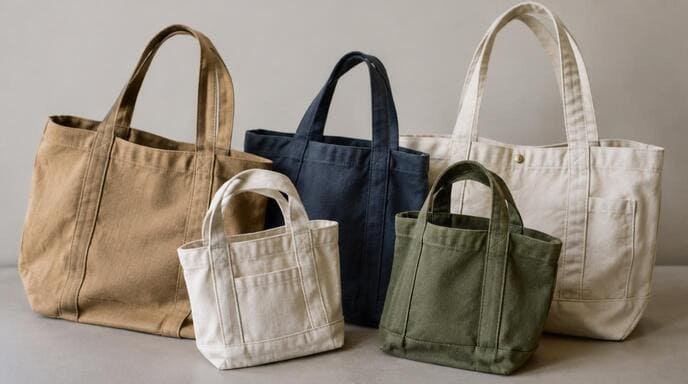
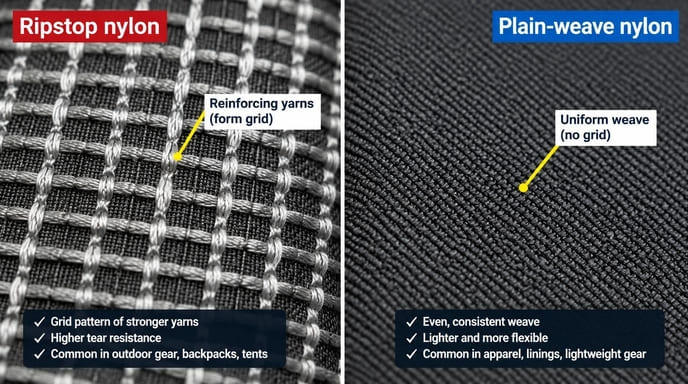
Ripstop nylon is a lightweight woven fabric designed to reduce the spread of tears. Its defining feature is a reinforcement grid woven into the fabric at regular intervals, usually with thicker yarns forming small squares or rectangles.
For outdoor bag manufacturers, travel gear brands, and wholesale buyers, ripstop nylon offers a practical balance of weight, tear resistance, and packability. However, it is not automatically stronger than every plain-weave nylon fabric, nor is it inherently waterproof. Its performance depends on yarn strength, fabric density, reinforcement spacing, coating, and construction quality.
This guide explains how ripstop nylon works, how it compares with ordinary nylon, and when it is a suitable material for backpacks, travel bags, and outdoor products.
What Is Ripstop Nylon, and How Does Its Grid Structure Work?
Ripstop nylon is a woven nylon fabric incorporating stronger reinforcement yarns at regular intervals. These yarns create a visible grid, commonly with spacing of a few millimeters, although the exact dimensions depend on the fabric specification.
The underlying principle is to interrupt the propagation of a tear. In an ordinary woven fabric, a tear may continue through adjacent yarns as local damage progresses. In ripstop fabric, the stronger grid yarns provide additional resistance at intervals, making it harder for the tear to extend freely.
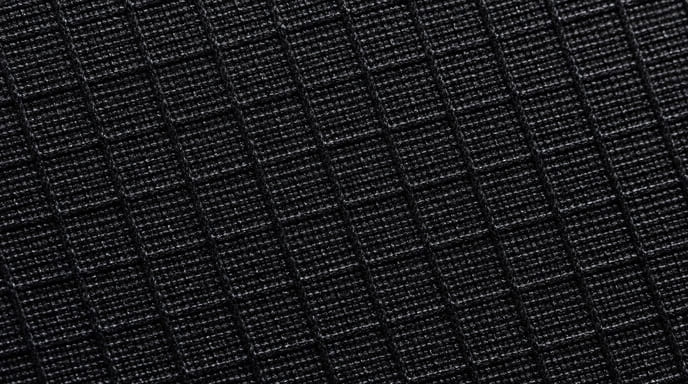
The reinforcement does not make the fabric tear-proof. A sharp object, concentrated force, damaged yarn, or poorly constructed seam can still cause failure. Instead, the grid helps limit the growth of certain tears and can reduce the likelihood that a small cut develops into a much larger opening.
Three factors determine how well the structure performs:
- Reinforcement yarn strength: Stronger grid yarns can provide greater resistance to tear propagation, depending on the surrounding construction.
- Grid spacing: The distance between reinforcement yarns influences the fabric's structure, appearance, flexibility, and tear behavior.
- Base fabric construction: Denier, weave density, yarn quality, and finishing all affect the final performance.
Ripstop nylon is therefore a construction method rather than a single standardized material grade. Two fabrics described as ripstop nylon may have substantially different weights and mechanical properties.
Ripstop Nylon vs. Ordinary Plain-Weave Nylon
The main difference is not necessarily the fiber itself, but how the yarns are arranged. Both fabrics can be made from nylon; ripstop adds a regular reinforcement grid, while ordinary plain-weave nylon typically has a more uniform yarn structure.
| Comparison factor | Ripstop nylon | Ordinary plain-weave nylon |
|---|---|---|
| Fabric structure | Reinforcement yarns form a grid | More uniform yarn arrangement |
| Tear propagation | Designed to limit the spread of tears | Depends on yarn strength and weave density |
| Weight | Can provide tear containment with little additional weight | Varies with yarn and fabric construction |
| Surface appearance | Visible or subtle grid | Usually a more uniform surface |
| Abrasion resistance | Depends on yarn, density, and finish | Depends on yarn, density, and finish |
| Water resistance | Requires appropriate finishing for water protection | Also depends on coating or finishing |
| Typical applications | Lightweight packs, stuff sacks, outdoor accessories | Bags, linings, travel products, and general-purpose applications |
The important distinction is tear containment versus overall durability. Ripstop construction can reduce tear propagation, but it does not guarantee better performance in every category.
For example, a lightweight ripstop fabric may resist a tear spreading more effectively than a plain-weave fabric of similar weight, yet still wear through faster when repeatedly rubbed against rough concrete or rock. A heavier plain-weave nylon may be a better choice for a bag base that experiences frequent abrasion.
When comparing materials, request test results for tear strength, tensile strength, and abrasion resistance rather than relying on the ripstop label alone. ISO 13937 is a relevant series of standards for measuring textile tear properties.
What Do 20D, 40D, 70D, and 210D Mean?
Denier (D) measures the linear mass of a yarn: 1 denier equals 1 gram per 9,000 metres of yarn. It is not a direct measurement of finished fabric thickness, weight per square metre, or strength.
Different denier specifications are used for different applications. The following ranges are practical starting points for material selection, not universal industry standards.
| Nylon specification | Potential application | Main consideration |
|---|---|---|
| 20D–40D ripstop | Ultralight packable bags, stuff sacks, compact accessories | Very low weight; needs careful handling and construction |
| 70D ripstop | Lightweight daypacks, travel organizers, rain covers | Balance of packability and everyday use |
| 100D–210D ripstop | General outdoor bags, travel bags, lightweight backpack panels | Greater material options for balancing weight and durability |
| 210D–420D or heavier | More demanding bag panels and selected gear applications | Assess abrasion, tear strength, stiffness, and finished weight |
These ranges overlap because denier alone does not determine performance. For example, a 70D ripstop fabric with a suitable coating may be appropriate for a packable accessory, while a 210D fabric may be preferable for a frequently used travel bag. Neither specification guarantees a particular service life.
A further consideration is whether the denier refers to the base yarn or the reinforcing yarn. Buyers should confirm both where the distinction matters, along with the finished fabric weight in GSM.
Why Is Ripstop Nylon Commonly Used for Outdoor Bags?
The appeal of ripstop nylon is its ability to manage small tears without requiring the entire fabric to be heavy. That makes it useful for products where portability matters as much as resistance to damage.
Lightweight backpacks
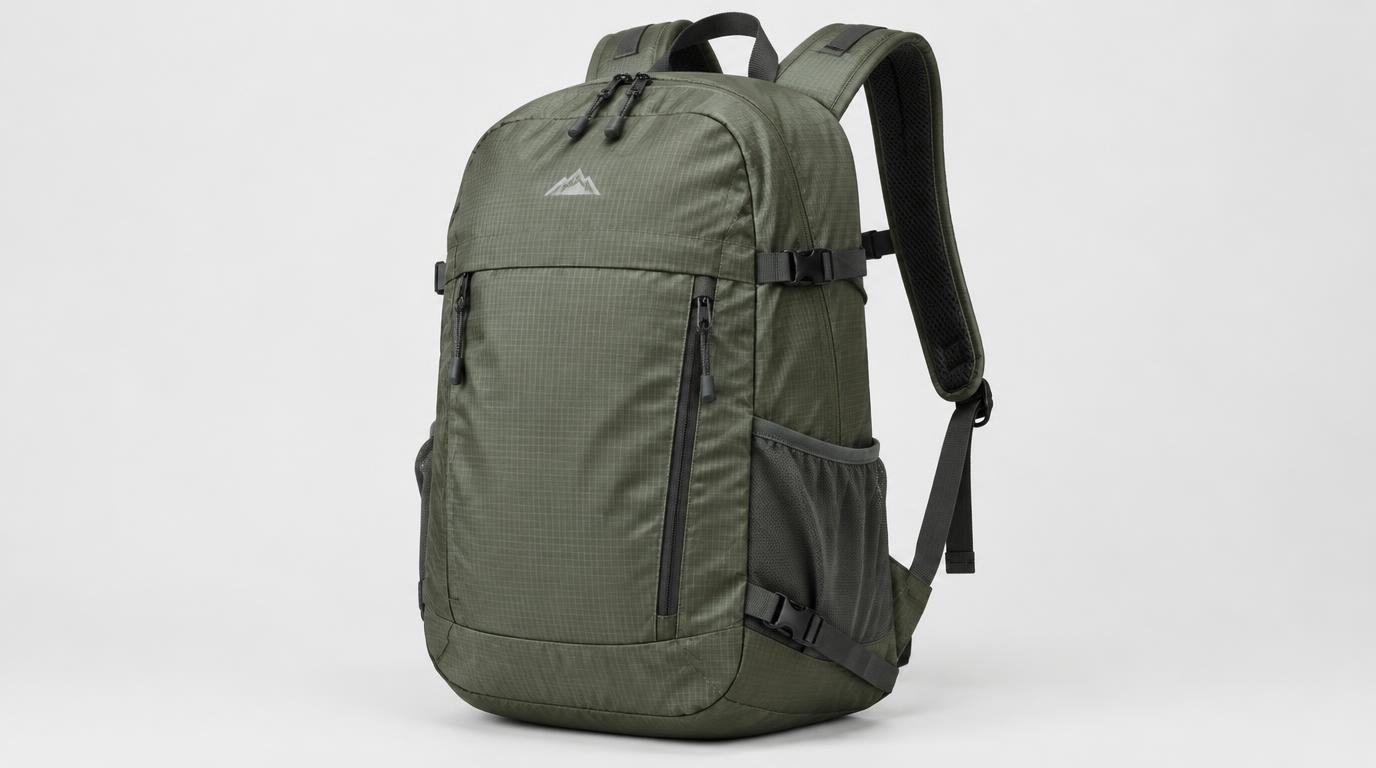
Fine ripstop fabrics can help reduce the weight of the main body, especially in daypacks, foldable backpacks, and packs intended for occasional hiking. However, shoulder straps, attachment points, and the bottom panel may require heavier fabrics or additional reinforcement.
Travel bags and organizers
Ripstop nylon is suitable for packing cubes, shoe bags, laundry bags, compact duffels, and foldable shopping bags. Its low weight and ability to fold into a small space are useful for products that spend part of their time stored inside another bag.
Outdoor accessories
Stuff sacks, rain covers, lightweight gear pouches, and selected camping accessories benefit from the combination of low weight and resistance to tear propagation. Coatings can be added when water protection is required.
Promotional and branded bags
For brands developing lightweight reusable bags or outdoor merchandise, ripstop can offer a technical appearance and a compact finished product. The choice should still reflect the intended load, expected reuse frequency, printing requirements, and target cost.
Ripstop nylon is less automatically suitable for bag bottoms, heavy equipment carriers, or products repeatedly dragged across rough surfaces. In these applications, a heavier fabric, a reinforced base, or a combination of materials may provide a more appropriate balance.
Does Ripstop Nylon Make a Bag Waterproof?
No. Ripstop describes the fabric's reinforcement structure, not its waterproof performance.
Water resistance is determined by factors including the coating or laminate, fabric construction, seam design, and closure system. Common options include polyurethane (PU) coatings and silicone finishes, depending on the intended application.
A coated ripstop fabric may resist rain or splashes, but that does not automatically mean a finished bag is waterproof. Water can still enter through needle holes, zippers, seams, or unprotected openings.
When specifying a bag, distinguish between three requirements:
- Water-repellent: Water tends to bead on the surface, depending on the finish.
- Water-resistant: The material or finished product offers a defined degree of protection under specified conditions.
- Waterproof: The complete construction must meet the intended water-exposure requirement, including seams and closures.
If a product needs a measurable level of protection, request a hydrostatic-head test result, such as one measured using ISO 811, and verify the finished bag under conditions that reflect actual use. A coating name alone is insufficient evidence of performance.
Manufacturer Analysis: How Should Buyers Specify Ripstop Nylon for Custom Bags?
From a manufacturing perspective, selecting ripstop nylon is not simply a matter of choosing the lightest available fabric. The objective is to match the material to the bag's load, wear points, production method, and expected service conditions.
Four checks are particularly useful before approving a bulk order.
1. Confirm the actual fabric specification
Request fiber composition, base-yarn denier, reinforcement-yarn details where available, GSM, grid spacing, coating, and usable width. Two suppliers quoting the same denier may be offering different finished fabrics.
2. Test the complete bag, not only the fabric
The body panel may perform well while the handle attachment or seam fails first. Evaluate seam strength, handle pull resistance, zipper performance, and load-bearing points under the intended conditions.
3. Balance weight against wear
A lightweight fabric can reduce shipping weight and improve packability, but may require reinforcement in high-stress areas. For a travel bag used daily, a heavier base panel paired with a lighter ripstop body can be more practical than using one fabric throughout.
4. Check printing and finishing compatibility
Surface coatings can affect ink adhesion, appearance, and color consistency. Confirm the selected printing process using a production-representative sample before approving large quantities.
For brands, wholesalers, and distributors sourcing custom bags, these checks help turn a broad material description into a reproducible purchasing specification. The most useful supplier comparison includes test methods and acceptance criteria, not just a quoted price per metre or per bag.
Frequently Asked Questions
Is ripstop nylon stronger than regular nylon?
It is designed to resist the spread of tears, but it is not necessarily stronger in tensile strength, abrasion resistance, or puncture resistance. The comparison depends on the complete fabric specifications and test results.
Does ripstop nylon last longer?
It may last longer when tear propagation is the main failure risk. Overall service life also depends on abrasion, UV exposure, coating degradation, seam quality, loading, and maintenance.
Is 210D ripstop nylon suitable for backpacks?
It can be suitable for lightweight or general-purpose backpack panels. For heavy loads or frequent contact with rough surfaces, evaluate abrasion and tear performance and consider reinforcing the base and stress points.
Can ripstop nylon be printed with a custom logo?
Yes, subject to the fabric's coating, surface treatment, and printing method. Sample testing is advisable to check adhesion, color accuracy, and resistance to rubbing.
Is ripstop nylon better than ripstop polyester?
Neither is universally better. Nylon is often selected where flexibility and mechanical performance are priorities, while polyester can be attractive for dimensional stability and UV-related requirements. Actual results depend on yarn quality, construction, finishing, and the intended environment.
Source Custom Ripstop Bags for Your Business
Choosing the right material is the first step toward developing a bag that meets your customers' expectations for weight, durability, appearance, and cost. The next step is to translate those requirements into a clear product specification.
If you are developing lightweight backpacks, travel bags, outdoor accessories, or custom promotional bags, contact Jiarong Packaging to discuss your product requirements, material options, logo printing, and bulk production needs. Share your intended application, target dimensions, expected load, and estimated order quantity to help establish a suitable starting specification and quotation.